
A cutting board may look like one of the simplest tools in the kitchen, but choosing the right one can make food preparation cleaner, more organized, and more enjoyable.
The best cutting board is not necessarily the largest, heaviest, or most expensive option. It is the board that fits the way you actually cook: the ingredients you prepare most often, the amount of counter space available, how you prefer to clean up, and whether the board will also be used for serving.
For most home kitchens, one board is rarely enough. A practical setup includes at least one board for fresh produce, bread, and ready-to-eat foods, plus a separate board for raw meat, poultry, or seafood. From there, the right material and size depend on your daily routine.
This guide compares wood, plastic, composite, glass, and stone cutting boards; explains how to choose the correct size; covers essential food-safety practices; and shows how one well-designed board can move naturally from kitchen prep to table presentation.
In This Guide
- Wood vs. Plastic vs. Composite Cutting Boards
- How to Choose the Right Cutting Board Size
- Why a Two-Board System Works Better
- Cutting Board Features That Matter
- How to Clean and Care for a Cutting Board
- How to Use a Cutting Board for Serving
- Frequently Asked Questions
The Quick Answer: What Is the Best Cutting Board?
For most everyday kitchens, the best cutting board should offer:
- Enough surface area to prepare food without crowding
- A stable base that does not slide during use
- A surface that is easy to clean
- A size that fits both the counter and storage space
- A design that supports both prep and serving
- Clear care instructions that match the household's routine
Material matters, but workflow matters more.
Choose wood when visual warmth and traditional kitchen styling are priorities. Choose plastic when lightweight handling and simple color-coding are most important. Choose composite when a slim profile, nonporous surface, and low-maintenance cleaning routine are preferred. Reserve glass or stone boards primarily for serving or light preparation rather than repetitive chopping.
The strongest setup is often a small collection of boards with different roles rather than one board expected to handle every task.
Wood vs. Plastic vs. Composite Cutting Boards

Each cutting board material offers a different combination of appearance, weight, maintenance, storage, and everyday usability. Understanding those differences makes it easier to choose a board that fits the kitchen instead of buying one based only on appearance.
Wood Cutting Boards
Wood cutting boards bring natural warmth to a kitchen and often look attractive enough to remain on the counter or move directly to the table.
They work especially well for bread, fruit, cheese, herbs, and general meal preparation. A substantial wooden board can also create a stable workspace for larger prep tasks.
The tradeoff is maintenance. Most wood boards should be washed by hand and dried promptly. Depending on the type of wood and finish, periodic oiling may also be necessary. Leaving a wood board wet, soaking it in water, or placing it in the dishwasher can lead to warping, splitting, or surface damage.
Wood Works Well For
- Bread and baked goods
- Fruits and vegetables
- Cheese and appetizer presentation
- Kitchens where natural materials are part of the décor
- Cooks comfortable with hand washing and routine care
Consider Before Buying
- Does it fit comfortably in the sink?
- Is it too heavy to move and clean easily?
- Does it require oiling?
- Is there enough space to dry it upright?
- Will it be used for prep, serving, or both?
Wood is a strong choice for cooks who value appearance and tactile warmth and do not mind a more hands-on care routine.
Plastic Cutting Boards
Plastic cutting boards are lightweight, widely available, and easy to assign to specific food categories. Different colors can be used for produce, bread, seafood, poultry, or meat, making the kitchen workflow easier to organize.
Many plastic boards are dishwasher safe, although the manufacturer's care instructions should always be checked first. Their low weight makes them easy to move, wash, and store.
Over time, however, plastic boards can develop visible cut marks and grooves. Once a board becomes excessively worn or difficult to clean thoroughly, it should be replaced.
Plastic Works Well For
- Color-coded food preparation
- Small kitchens
- Quick daily prep
- Households that prefer dishwasher cleanup
- Separate use for raw proteins
Consider Before Buying
- Does the board remain stable on the counter?
- Does it include non-slip edges or feet?
- Is it thick enough to resist bending?
- Is it approved for dishwasher cleaning?
- How easily does the surface show deep cut marks?
Plastic offers convenience, but the board should be inspected regularly for wear.
Composite Cutting Boards
Composite cutting boards are made by combining materials such as wood fiber with resin to create a dense, streamlined cutting surface. They are designed to provide the visual warmth of a natural-toned board with a lower-maintenance daily routine.
A composite board can be a practical choice for kitchens where storage space, easy handling, and cleanup are important. Its slim profile makes it easier to store vertically, while a nonporous surface can help simplify routine cleaning.
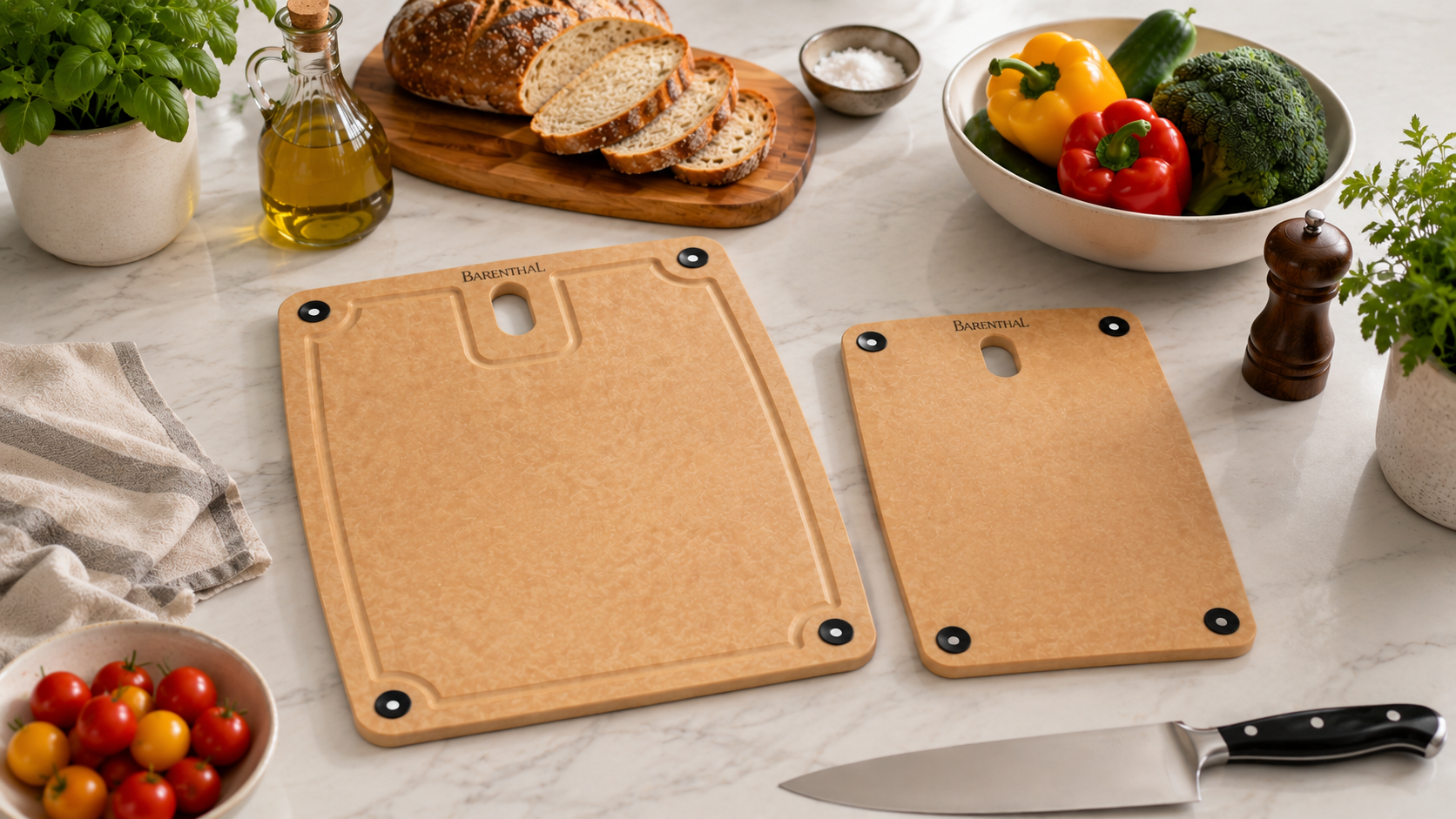
The Barenthal 2-Piece Composite Cutting Board Set is made from composite wood fiber and is available in multiple size combinations. Its reversible surfaces support different prep tasks, while the larger boards include a juice groove and non-slip silicone feet. The boards are also designed for dishwasher cleaning.
Composite Works Well For
- Everyday meal preparation
- Kitchens with limited storage space
- Cooks who prefer a thinner, lighter board
- Households that want multiple board sizes
- Prep that transitions into casual serving
- Users who prefer dishwasher-compatible kitchen tools
Consider Before Buying
- Which size combination fits the daily routine?
- Is a juice groove needed for carving or juicy ingredients?
- Does the board include non-slip features?
- Will both sides be used for different tasks?
- Does the manufacturer approve dishwasher cleaning?
Composite boards are particularly useful when a kitchen needs one coordinated system for small prep, larger meals, and casual presentation.
Explore Barenthal Composite Cutting Boards

Glass and Stone Cutting Boards
Glass, marble, and stone boards offer a polished, decorative appearance and are easy to wipe clean. They can work beautifully as serving surfaces for pastries, cheese, fruit, or desserts.
For frequent chopping, however, these very hard surfaces can feel noisy and unforgiving. They may also become slippery when wet unless the board includes a textured surface or non-slip base.
Glass and Stone Work Well For
- Serving cheese, pastries, or desserts
- Light slicing
- Decorative countertop display
- Tasks that do not require repetitive chopping
Consider Before Buying
- Does the board remain stable?
- Is the surface textured or slippery?
- Is the weight practical for daily handling?
- Will it be used primarily for serving or cutting?
For most home cooks, glass and stone are better treated as presentation surfaces than as the primary everyday chopping board.
Cutting Board Material Comparison
Choose Wood When:
- Natural appearance is a priority
- The board will also be used for serving
- Hand washing is not a problem
-
The kitchen has space for proper drying and storage
Choose Plastic When:
- Lightweight handling is most important
- Different colors will be assigned to different food groups
- Dishwasher compatibility is a priority
- The board can be replaced when it becomes heavily worn
Choose Composite When:
- A slim, nonporous surface is preferred
- Easy storage matters
- The board needs to move from prep to serving
- Multiple coordinated sizes would improve the kitchen workflow
- Dishwasher cleaning is part of the daily routine
Choose Glass or Stone When:
- Presentation is more important than heavy chopping
- The board will mainly hold cheese, desserts, or appetizers
- A decorative serving surface is needed
There is no single perfect material for every household. The best choice depends on how often the board is used, what is prepared on it, and how it will be cleaned.
How to Choose the Right Cutting Board Size

A board can be made from the right material and still be frustrating if the size does not match the task.
A board that is too small forces ingredients into a crowded workspace. Chopped food can fall onto the counter, and there may not be enough room to keep prepared ingredients separate from uncut ingredients.
A board that is too large can be difficult to wash, dry, lift, and store. Before buying, check the dimensions of the counter, sink, dishwasher, cabinet, and vertical storage space.
Small Cutting Boards
Small boards work best for quick, focused tasks:
- Cutting lemons and limes
- Preparing a small amount of fruit
- Slicing cheese
- Chopping herbs or garlic
- Preparing garnishes
- Serving a small snack
A small board is useful, but it should not be expected to handle a full dinner preparation.
The Barenthal small composite board measures approximately 7.68 × 10.35 inches, giving it a compact footprint for quick prep and limited counter space.
Medium Cutting Boards
Medium boards are versatile enough for many daily tasks:
- Preparing vegetables
- Slicing sandwiches
- Cutting fruit
- Chopping herbs
- Preparing breakfast or lunch
- Serving bread or appetizers
The Barenthal medium composite board measures approximately 8.58 × 12.5 inches. This size balances usable space with easy handling and storage.
Large Cutting Boards
Large boards provide more room for meal preparation:
- Preparing several vegetables at once
- Carving cooked proteins
- Slicing bread
- Organizing ingredients for dinner
- Preparing larger appetizer displays
- Serving food at the table
The Barenthal large composite board measures approximately 10.75 × 14.5 inches and includes a juice groove to help contain liquid during slicing or carving.
Extra-Large Cutting Boards
An extra-large board creates a generous workstation for:
- Batch cooking
- Holiday meal preparation
- Large cuts of meat
- Multiple ingredients
- Family-size meal preparation
- Oversized serving displays
The Barenthal XL reversible cutting board measures approximately 18.8 × 15.6 inches. Before selecting an extra-large board, confirm that it fits inside the sink or dishwasher and can be stored safely after use.
View the Barenthal XL Reversible Cutting Board
Why a Two-Board System Works Better
A two-board system creates a clearer and safer kitchen workflow.
Use one board for:
- Fresh fruit
- Vegetables
- Bread
- Cheese
- Herbs
- Cooked foods
- Ready-to-eat ingredients
Use a separate board for:
- Raw meat
- Raw poultry
- Raw seafood
This separation reduces the chance that juices from raw proteins will come into contact with foods that may be eaten without further cooking.
A two-piece cutting board set also provides more flexibility. The smaller board can handle quick prep while the larger board remains available for a full meal, carving, or serving. Different sizes are easier to assign to specific tasks and easier to rotate while one board is being washed.

Features That Matter on an Everyday Cutting Board

Material and size are only part of the decision. The smaller design details often determine whether a board feels practical during daily use.
Non-Slip Feet or Edges
A board should remain stable while cutting. Non-slip silicone feet, rubberized corners, or a secure non-slip base help reduce movement on smooth countertops.
Before using any board, place it on a clean, dry surface. If the board moves, secure it before cutting.
Juice Grooves
A juice groove is useful when preparing:
- Tomatoes
- Citrus
- Watermelon
- Roasts
- Cooked poultry
- Other ingredients that release liquid
A groove can help contain liquid, but it also requires careful cleaning. Wash along the entire channel so that food residue does not remain in the corners.
Reversible Surfaces
A reversible cutting board provides two usable sides. One side can be reserved for general chopping, while the other can be used for bread, fruit, or presentation.
The two sides should still be cleaned after each task. Reversible does not mean one side can remain unwashed between different food categories.
Handles and Hanging Holes
A built-in handle or opening can make a board easier to lift, carry, hang, and remove from storage. This is especially useful for thin composite boards or boards that move frequently between the kitchen and table.
Weight and Thickness
A heavier board may feel stable but can be difficult to wash. A very thin board may store easily but should still remain flat and secure.
The right balance depends on the user. A board should feel substantial enough to stay in place but manageable enough to clean without difficulty.
How to Clean and Care for a Cutting Board

Good care protects the board and helps maintain a cleaner food-preparation routine.
After Every Use
- Remove food residue from the surface.
- Wash the board with hot, soapy water.
- Rinse it thoroughly.
- Dry it completely before storage.
- Store it upright or in a position that allows airflow.
Do not leave a used cutting board sitting wet in the sink. Moisture and food residue make cleanup more difficult and can damage materials that are not designed for soaking.
Dishwasher Cleaning
Only place a cutting board in the dishwasher when the manufacturer identifies it as dishwasher safe.
Many plastic and composite boards are designed for dishwasher cleaning. Traditional wood boards generally require hand washing unless their care instructions state otherwise.
Barenthal composite cutting boards are designed for dishwasher cleaning, creating a convenient option for households that prefer a simpler cleanup routine.
After Preparing Raw Meat, Poultry, or Seafood
Wash the cutting board, knife, utensils, and surrounding work surface thoroughly before preparing another food.
Do not place cooked food back onto an unwashed board that previously held raw protein.
Using a separate board for raw proteins makes this workflow easier to manage.
When to Replace a Cutting Board
Replace a board when it develops:
- Deep grooves that are difficult to clean
- Cracks or splits
- Warping that prevents stable use
- Peeling or damaged surfaces
- Persistent odors that remain after cleaning
- Areas where food residue becomes trapped
A cutting board is a working kitchen surface. Visible wear is normal, but damage that affects cleaning or stability is a sign that the board should be retired.
Can a Cutting Board Be Used as a Serving Board?

Yes. A clean cutting board can also serve as a practical presentation surface.
Use it to serve:
- Bread and rolls
- Cheese and crackers
- Fruit
- Pastries
- Appetizers
- Sandwiches
- Desserts
- Small bites for casual gatherings
A board used for serving should be thoroughly cleaned and should not be the same unwashed surface used for raw meat, poultry, or seafood.
Composite boards work well in this role because their clean profile can move easily from prep to table. A small board can hold snacks or cheese, while a larger board can create a shared centerpiece for bread, fruit, or appetizers.
How to Match a Cutting Board with the Right Knife
A cutting board and knife function as a system. The board creates the workspace, while the knife performs the task.
Use:
- A chef's knife for general chopping and slicing
- A santoku knife for vegetables and everyday prep
- A bread knife for loaves and pastries
- A paring knife for small fruit and detailed work
- A slicing or carving knife for cooked proteins
- Kitchen shears for herbs, packaging, and smaller prep tasks
The board should provide enough space for the knife to move safely. A large chef's knife on a tiny board creates a crowded workspace, while a properly sized board allows room for both cutting and ingredient organization.
The Best Cutting Board Setup for Different Kitchens
For a Small Apartment Kitchen
Choose:
- One small board for quick prep
- One medium board for vegetables and meals
- Thin boards that store vertically
- A design that can also be used for serving
The Small + Medium Barenthal composite set provides two working surfaces without requiring excessive cabinet space.
For a Family Kitchen
Choose:
- One medium or large board for daily prep
- A separate board for raw proteins
- A juice groove for larger ingredients
- Dishwasher-compatible boards for easier cleanup
The Medium + Large combination creates enough space for both quick tasks and full family meals.
For Frequent Entertaining
Choose:
- One extra-large prep board
- One smaller board for garnishes or cheese
- A presentation-ready board for serving
- A carving knife or complete knife set
An XL board provides space for batch preparation and larger serving arrangements.
For a Minimalist Kitchen
Choose:
- Two reversible boards
- Neutral materials
- Slim profiles
- Multipurpose designs
- Pieces that move from prep to serving
The goal is not to own many boards. It is to own a small number of boards with clearly defined roles.
Shop Barenthal Cutting Boards
Barenthal 2-Piece Composite Cutting Board Set
Available in Small + Large, Small + Medium, and Medium + Large combinations, this two-board system supports quick prep, full meal preparation, food separation, and casual serving.
Shop the 2-Piece Composite Cutting Board Set
Barenthal XL Reversible Cutting Board
The extra-large reversible surface provides more room for batch cooking, carving, family meal preparation, and larger serving displays. Non-slip feet and a juice groove support a more organized prep space.
Shop the XL Reversible Cutting Board
Barenthal Knife Sets
Pair the right cutting surface with the appropriate kitchen knife for slicing, chopping, carving, and everyday food preparation.

Frequently Asked Questions
What Is the Best Cutting Board Material?
The best cutting board material depends on how the board will be used and cleaned. Wood offers a warm, traditional appearance but usually requires hand washing and occasional maintenance. Plastic is lightweight and often dishwasher safe but should be replaced when heavily worn. Composite boards provide a slim, nonporous surface and can offer easier cleaning when the manufacturer approves dishwasher use.
Is Wood, Plastic, or Composite Better for a Cutting Board?
No single material is best for every kitchen. Wood suits cooks who value natural appearance and do not mind hand care. Plastic works well for lightweight, color-coded preparation. Composite is useful for households that want a thin, easy-to-store board with a lower-maintenance cleaning routine. The right choice should match cooking habits, storage space, and cleanup preferences.
How Many Cutting Boards Should a Kitchen Have?
Most kitchens benefit from at least two cutting boards. Use one for fresh produce, bread, cheese, cooked food, and other ready-to-eat ingredients. Keep a separate board for raw meat, poultry, and seafood. Additional small and large boards can make quick prep, full meals, and serving easier to organize.
Should Raw Meat and Vegetables Use Different Cutting Boards?
Yes. Keep raw meat, poultry, and seafood separate from fresh produce and foods that will be eaten without further cooking. A dedicated board reduces the chance that raw juices will transfer to ready-to-eat foods. Both boards should still be washed thoroughly after every use.
What Size Cutting Board Is Best for Everyday Use?
A medium or large board works well for most everyday meal preparation. It should provide enough room to cut ingredients without crowding but still fit inside the sink, dishwasher, and storage area. A smaller second board is helpful for fruit, herbs, garnishes, cheese, and quick prep.
Are Composite Cutting Boards Dishwasher Safe?
Dishwasher safety depends on the specific product. Always check the manufacturer's care instructions. Barenthal composite cutting boards are designed for dishwasher cleaning, making them suitable for households that prefer a simpler cleanup routine.
What Is the Purpose of a Juice Groove?
A juice groove helps collect liquid released while slicing tomatoes, citrus, watermelon, roasts, poultry, and other moist ingredients. It can help keep liquid from spreading across the counter. The groove must be washed carefully after use so that food residue does not remain in the channel.
Are Reversible Cutting Boards Useful?
Yes. Reversible boards provide two usable work surfaces and make it easier to assign different sides to different tasks. One side may be used for general chopping while the other is used for bread, fruit, or serving. Both sides still require cleaning after each use.
When Should a Cutting Board Be Replaced?
Replace a cutting board when it becomes excessively worn, develops deep grooves that are difficult to clean, cracks, warps, peels, or no longer remains stable on the counter. A board should also be replaced if persistent odors or trapped residue remain after proper washing.
Can a Cutting Board Be Used for Serving Food?
Yes. A clean cutting board can be used to serve bread, cheese, fruit, appetizers, pastries, sandwiches, or desserts. Keep presentation boards separate from unwashed surfaces used for raw proteins. A neutral, well-designed board can add texture and function to an everyday table without requiring a separate serving tray.
Food Safety Sources
Food-safety guidance in this article follows public recommendations from the U.S. Food and Drug Administration and the USDA Food Safety and Inspection Service regarding cutting-board separation, cleaning, and replacement.
Final Thoughts
The best cutting board is not defined by one material or one size. It is defined by how well it supports the way food is prepared, cleaned, stored, and served.
A small board makes quick tasks easier. A larger board creates space for full meals. Separate boards help organize raw and ready-to-eat foods. A reversible composite board can move from weekday prep to casual serving without adding unnecessary complexity to the kitchen.
Choose a cutting board that fits the counter, the sink, the storage space, and the daily routine. The right surface should make preparation feel safer, cleanup feel simpler, and the movement from kitchen to table feel more natural.
Prepare thoughtfully. Serve beautifully. Make every everyday meal feel considered.