
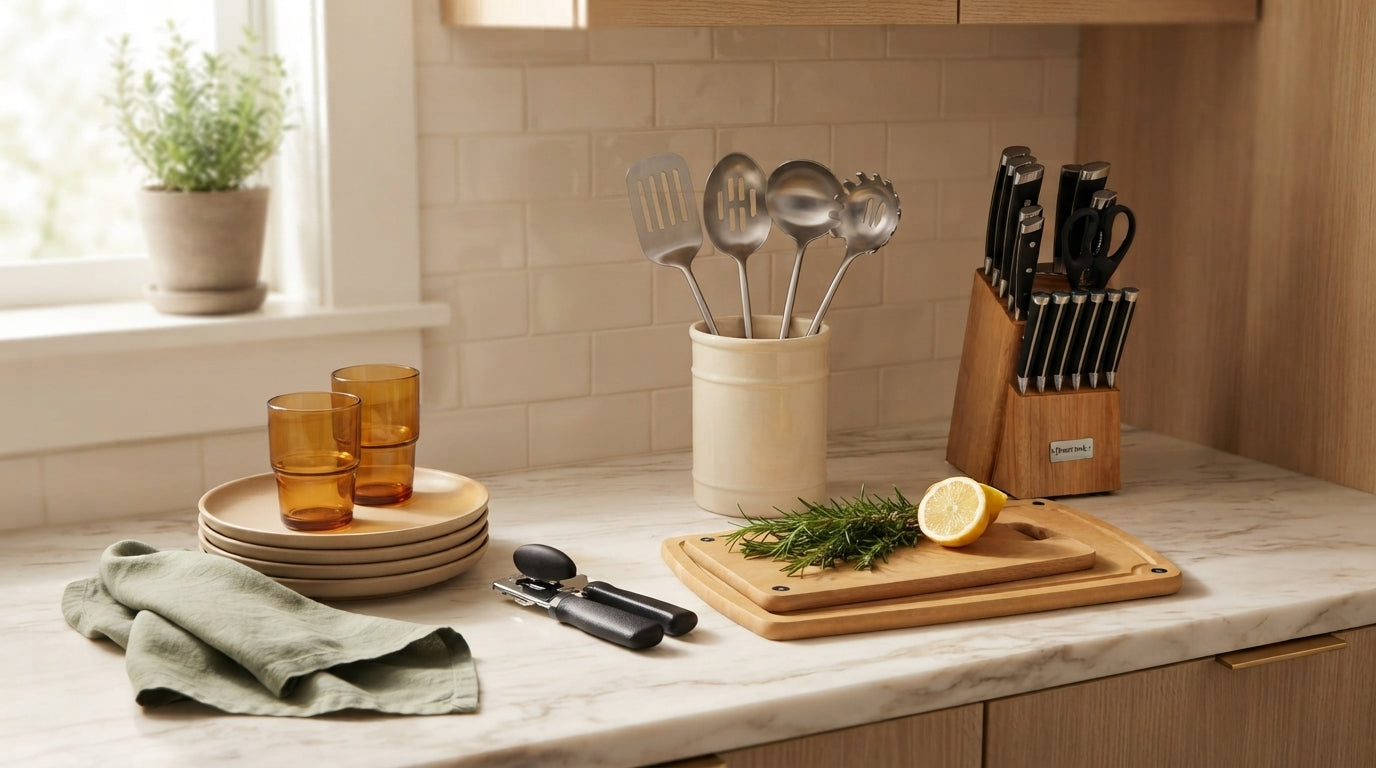
Setting up a first kitchen can feel overwhelming. There are endless tools, gadgets, cookware pieces, knives, boards, utensils, storage items, and tableware options — but not every kitchen needs everything at once.
A useful kitchen is not built by filling every drawer. It is built by choosing pieces that support the way food is actually prepared, cooked, served, cleaned, and enjoyed. The strongest kitchen setup should help with everyday meals first, then add flexibility for hosting, family dinners, holidays, and special occasions.
For a first apartment, first home, kitchen reset, wedding registry, or housewarming setup, the goal is simple: build a foundation that makes cooking easier without creating clutter.
This guide breaks down the kitchen essentials every home should understand, from knives and cutting boards to cooking utensils, can openers, flatware, serving pieces, storage, and table-ready tools. It also explains what to buy first, what can wait, and how to build a practical kitchen over time.
In This Guide
- The Quick Answer: What Does a First Kitchen Really Need?
- First Kitchen Essentials by Category
- Prep Tools: Cutting Boards, Knives, and Shears
- Cooking Tools: Utensils, Cookware, and Everyday Helpers
- Tableware: Flatware, Plates, Glassware, and Napkins
- Serving Essentials for Everyday Meals and Guests
- Storage and Organization Essentials
- Cleaning and Care Essentials
- What to Buy First, What to Add Later
- What First Kitchens Often Do Not Need Right Away
- How to Build a Kitchen That Works from Prep to Table
- Shop Barenthal Knife and Prep Essentials
- Frequently Asked Questions
The Quick Answer: What Does a First Kitchen Really Need?
A first kitchen needs tools that support daily cooking, safe prep, simple serving, and easy cleanup.
The most useful starter kitchen essentials include:
- Chef’s knife
- Paring knife
- Bread knife
- Cutting board
- Cooking utensil set
- Can opener
- Mixing bowl
- Measuring cups and spoons
- Tongs
- Whisk
- Saucepan
- Frying pan
- Sheet pan
- Flatware set
- Dinnerware
- Glassware
- Serving spoon
- Ladle
- Food storage containers
- Dish towels
- Drawer organizer
A complete kitchen can grow over time, but the first setup should focus on tools that get used every week. A knife set supports prep. A cutting board creates a stable work surface. Cooking utensils help stir, lift, turn, drain, and serve. Flatware makes everyday dining feel complete. A can opener supports pantry meals. Serving pieces help move food from kitchen to table.
A first kitchen does not need every specialty tool. It needs a clear foundation.
First Kitchen Essentials by Category

The easiest way to set up a kitchen is by category. Instead of buying random tools one at a time, organize the kitchen around real tasks.
Everyday kitchen tasks usually fall into five groups:
- Preparing food
- Cooking food
- Serving food
- Eating meals
- Cleaning and storing tools
Each category needs a few essential pieces.
Prep Essentials
Prep tools are used before food reaches the stove or table.
A strong prep setup includes:
- Knife set
- Cutting board
- Kitchen shears
- Mixing bowl
- Measuring cups
- Measuring spoons
- Colander
- Peeler
- Grater
- Food storage containers
Prep tools should be easy to reach because they are used at the beginning of nearly every meal.
Cooking Essentials
Cooking tools help move food through heat, liquid, oil, sauce, and cookware.
A practical cooking setup includes:
- Soup ladle
- Slotted spoon
- Slotted spatula
- Pasta spoon
- Tongs
- Whisk
- Flexible spatula
- Wooden spoon
- Saucepan
- Frying pan
- Stockpot
- Sheet pan
A compact kitchen can start with fewer pieces, then add more based on what the home cooks most often.
Dining Essentials
Dining tools support the meal at the table.
A first dining setup includes:
- Dinner forks
- Dinner knives
- Dinner spoons
- Teaspoons
- Salad forks
- Dinner plates
- Bowls
- Glasses
- Napkins
- Placemats or simple table linens
A 20-piece flatware set is often a strong starting point because it usually supports four complete place settings.
Serving Essentials
Serving pieces become important when food is shared.
A starter serving setup includes:
- Serving spoon
- Slotted serving spoon
- Ladle
- Pastry server
- Serving board
- Cutting board
- Small tongs
- Dessert forks or teaspoons
Serving tools prevent guests from using personal flatware in shared dishes and help the table feel more organized.
Prep Tools: Cutting Boards, Knives, and Shears

Prep tools shape the entire cooking experience. When food preparation feels controlled, meals become easier to finish and serve.
The most important prep tools are knives and cutting boards. These two pieces work together. The knife performs the cut, while the board creates the workspace.
Knife Set
A first kitchen should have at least three knives:
- Chef’s knife
- Bread knife
- Paring knife
A more complete kitchen can add:
- Santoku knife
- Utility knife
- Slicing knife
- Steak knives
- Kitchen shears
- Sharpening steel
A complete knife block set can help keep these tools organized in one place. This is useful for first homes because it creates a clear prep station instead of leaving knives loose in drawers.
Cutting Board
A cutting board is one of the most-used kitchen surfaces.
Use a cutting board for:
- Vegetables
- Fruit
- Bread
- Herbs
- Cheese
- Cooked proteins
- Appetizers
- Everyday prep
- Casual serving
A first kitchen works best with at least two cutting boards. One can be used for produce, bread, cheese, and ready-to-eat foods. Another can be reserved for raw meat, poultry, or seafood.
Kitchen Shears
Kitchen shears are useful for quick tasks that do not always need a knife.
Use kitchen shears for:
- Cutting herbs
- Opening packaging
- Trimming parchment
- Cutting kitchen twine
- Snipping scallions
- Opening food bags
- Small prep tasks
Kitchen shears are not a replacement for knives, but they make daily cooking more efficient.
Cooking Tools: Utensils, Cookware, and Everyday Helpers

Cooking utensils help control food while it is being cooked.
A first kitchen should not depend on one spoon for every task. Different tools solve different cooking problems.
Cooking Utensil Set
A four-piece cooking utensil set can be a strong foundation when it includes:
- Soup ladle
- Slotted spoon
- Slotted spatula
- Pasta spoon
These four tools support liquids, draining, lifting, turning, and serving.
Soup Ladle
A ladle is used for:
- Soups
- Stews
- Broths
- Sauces
- Chili
- Curry
- Gravy
- Pancake batter
A ladle helps serve liquids more cleanly than a standard spoon.
Slotted Spoon
A slotted spoon is used to lift food while leaving liquid behind.
Use it for:
- Boiled vegetables
- Dumplings
- Poached eggs
- Beans
- Pasta pieces
- Fried foods
- Foods cooked in broth or sauce
It helps keep plates cleaner by draining excess liquid before serving.
Slotted Spatula
A slotted spatula helps turn and lift food.
Use it for:
- Eggs
- Pancakes
- Fish
- Burgers
- Grilled sandwiches
- Roasted vegetables
- Sautéed foods
The slots allow extra liquid or oil to drain as food is lifted.
Pasta Spoon
A pasta spoon helps lift and serve noodles.
Use it for:
- Spaghetti
- Linguine
- Fettuccine
- Pasta salads
- Noodles
- Tossed vegetables
- Family-style serving
A pasta spoon is useful beyond pasta because it can help move long or mixed foods more easily.
Can Opener

A can opener is one of the most basic kitchen tools, but it is often forgotten during a first kitchen setup.
Use a can opener for:
- Soup cans
- Tomatoes
- Beans
- Vegetables
- Tuna
- Pantry staples
- Sauces
- Broths
A built-in bottle opener adds extra function without taking up more drawer space.
Tableware: Flatware, Plates, Glassware, and Napkins

A first kitchen is not complete without pieces for eating and serving meals.
Tableware should be practical enough for daily use and polished enough for guests. Matching pieces make the table feel more organized, even when the meal is simple.
Flatware
A complete flatware setup usually includes:
- Dinner forks
- Salad forks
- Dinner knives
- Dinner spoons
- Teaspoons
A 20-piece flatware set usually supports four place settings, making it useful for small households, apartments, couples, and first homes.
How Many Flatware Pieces to Start With
- 1–2 people can start with a 20-piece set.
- 3–4 people need at least a 20-piece set.
- Frequent hosts may need extra individual pieces.
- Larger households can build toward a 64-piece set.
Dinner forks and teaspoons often run out first, so those are useful add-on pieces over time.
Dinnerware
A starter dinnerware setup includes:
- Dinner plates
- Salad plates
- Bowls
- Small dessert plates
Choose simple pieces that work for breakfast, lunch, dinner, and hosting.
Glassware
A first kitchen should include:
- Water glasses
- Mugs
- Wine glasses or multipurpose stemware
- Tall glasses if the household serves iced drinks often
Glassware should be easy to store and easy to replace if needed.
Napkins and Table Linens
Napkins help a table feel more finished.
Start with:
- Everyday napkins
- A few cloth napkins for guests
- Placemats or a simple runner
- Neutral colors that work with different meals
The goal is not to make every meal formal. The goal is to make the table feel intentional.
Serving Essentials for Everyday Meals and Guests

Serving tools make shared meals easier.
A first kitchen may not need a full formal serving collection immediately, but it should have enough pieces to serve family-style meals, guests, dessert, and shared dishes.
Starter Serving Pieces
A useful starter setup includes:
- Serving spoon
- Slotted serving spoon
- Ladle
- Pastry server
- Small tongs
- Serving board
- Cutting board
- Dessert forks or teaspoons
Serving Spoon
Use a serving spoon for:
- Rice
- Potatoes
- Vegetables
- Pasta
- Casseroles
- Salads
- Family-style sides
Gravy Ladle
Use a gravy ladle for:
- Gravy
- Sauces
- Dressings
- Dessert sauces
- Warm syrup
- Au jus
A ladle gives guests more control and keeps the table cleaner.
Pastry Server
Use a pastry server for:
- Cake
- Pie
- Tart
- Cheesecake
- Brownies
- Quiche
- Dessert bars
A pastry server supports slices from underneath so desserts stay intact.
Serving Board
A clean cutting board or serving board can hold:
- Bread
- Cheese
- Fruit
- Crackers
- Appetizers
- Small desserts
- Sliced meats
A board adds warmth and structure to the table without requiring a separate decorative tray.
Storage and Organization Essentials

A first kitchen should be easy to use every day.
Good organization makes cooking faster because the tools are easier to find.
Drawer Organizer
Use a drawer organizer for:
- Dinner forks
- Salad forks
- Dinner knives
- Dinner spoons
- Teaspoons
- Serving pieces
Keeping flatware separated makes table setting faster and prevents drawers from becoming messy.
Knife Block or Protected Knife Storage
Knives should not move loosely in a drawer.
Use:
- Knife block
- Knife tray
- Blade guards
- Magnetic strip
- Protected storage system
A knife block is especially useful when several knives are used often. It keeps prep tools visible and easy to reach.
Utensil Crock or Hanging Rail
Store daily cooking utensils near the stove.
A utensil crock works well for:
- Ladle
- Pasta spoon
- Slotted spoon
- Spatula
- Wooden spoon
A hanging rail works well for utensils with loops. A drawer works better for kitchens with limited counter space.
Food Storage Containers
Food storage containers support:
- Leftovers
- Meal prep
- Cut fruit
- Washed vegetables
- Sauces
- Lunches
- Pantry organization
Choose containers that stack neatly and fit the refrigerator comfortably.
Cleaning and Care Essentials
Kitchen tools last longer when they are cleaned and stored properly.
A first kitchen should include simple cleaning pieces that are used daily.
Cleaning Basics
A practical cleaning setup includes:
- Dish soap
- Soft sponge
- Dish brush
- Dish towels
- Drying rack
- Microfiber cloth
- Sink strainer
- Trash bags
- Food storage bags or containers
- Surface cleaner suitable for the countertop
After Cooking
- Wash tools after use.
- Dry knives before storing.
- Dry wood handles promptly.
- Do not leave knives soaking in the sink.
- Clean cutting boards after each task.
- Store flatware only when fully dry.
- Keep utensils in a dry drawer, crock, or hanging area.
Care for Stainless Steel Tools
- Use mild dish soap.
- Avoid harsh scrubbers.
- Dry after washing to reduce water spots.
- Store polished pieces separately from rough tools when possible.
Care for Wooden Handles
- Avoid soaking.
- Do not leave wet wooden handles in the sink.
- Dry promptly after washing.
- Hand washing helps preserve the appearance over time.
What to Buy First, What to Add Later

A first kitchen can be built in stages. This prevents overspending and keeps the kitchen from becoming cluttered.
Stage 1: Daily Cooking Foundation
Start with the tools needed for simple meals.
- Knife set
- Cutting board
- Cooking utensil set
- Can opener
- Frying pan
- Saucepan
- Sheet pan
- Mixing bowl
- Measuring cups and spoons
- Flatware set
- Plates, bowls, and glasses
This stage supports breakfast, lunch, dinner, and basic prep.
Stage 2: Better Prep and Organization
Add pieces that make cooking smoother.
- Additional cutting board
- Kitchen shears
- Colander
- Peeler
- Tongs
- Whisk
- Drawer organizer
- Food storage containers
- Knife block or protected storage
This stage helps the kitchen feel more organized and efficient.
Stage 3: Everyday Serving
Add pieces that make shared meals easier.
- Serving spoon
- Slotted serving spoon
- Ladle
- Serving board
- Dessert forks or teaspoons
- Cloth napkins
- Simple table linens
This stage helps food move from kitchen to table more naturally.
Stage 4: Hosting and Special Occasions
Add pieces for guests, holidays, and larger meals.
- Larger flatware set
- Extra individual forks and teaspoons
- Pastry server
- Gravy ladle
- Carving knife and fork
- Steak knives
- Tiered serving stand
- Dessert plates
- Extra serving utensils
This stage helps the kitchen support hosting without last-minute scrambling.
What First Kitchens Often Do Not Need Right Away
A first kitchen can become cluttered quickly when too many specialty tools are purchased at once.
Many homes do not need these immediately:
- Single-use slicers
- Specialty avocado tools
- Oversized serving platters
- Multiple cake stands
- Too many mugs
- Too many duplicate spatulas
- Formal-only flatware
- Specialty baking tools
- Large roasting pans used once a year
- Decorative tools with no daily function
These pieces can be added later if the household actually uses them.
Simple Rule
If a tool only solves a problem once a year, it does not belong in the first kitchen setup.
Start with tools used every week. Add specialty pieces when the need becomes real.
How to Build a Kitchen That Works from Prep to Table
A strong kitchen should support the full meal flow.
The process usually looks like this:
- Prepare ingredients.
- Cook the meal.
- Serve the food.
- Set the table.
- Store leftovers.
- Clean and reset the kitchen.
Each step needs the right tools.
Prep to Table Setup
- Use knives and cutting boards for preparation.
- Use cooking utensils for stirring, lifting, turning, and serving.
- Use a can opener for pantry ingredients.
- Use flatware and dinnerware for everyday meals.
- Use serving pieces for shared food.
- Use storage containers for leftovers.
- Use organizers so everything is easy to find again.
This is what makes a first kitchen feel complete. The pieces work together instead of sitting separately in drawers and cabinets.
Shop Barenthal Kitchen and Dining Essentials
Barenthal 17-Piece Knife Set with Block
A complete kitchen knife set with prep knives, steak knives, sharpening steel, kitchen shears, and acacia wood storage block for organized everyday cooking.
Shop Barenthal 17-Piece Knife SetBarenthal 2-Piece Composite Cutting Board Set
Two coordinated cutting board sizes for quick prep, full meal preparation, food separation, and casual serving.
Shop Barenthal Composite Cutting BoardsBarenthal 4-Piece Cooking Utensil Set
A stainless steel kitchen utensil set with wooden handles for soups, pasta, vegetables, turning, draining, and everyday cooking.
Shop Barenthal 4-Piece Cooking Utensil SetBarenthal Manual Can Opener with Built-in Bottle Opener
A compact everyday kitchen tool for opening cans and bottles with one practical piece.
Shop Barenthal Manual Can OpenerBarenthal Bastia 20-Piece Silverware Set, Service for 4
A polished flatware set for four-person place settings, everyday meals, first homes, and small-table dining.
Shop Barenthal Bastia 20-Piece Silverware SetBarenthal Couture 2-Piece Serving Set
A polished serving set with a gravy ladle and pastry server for sauces, desserts, pastries, and shared table moments.
Shop Barenthal Couture 2-Piece Serving SetBarenthal Cookware Bundle – Practical Choices
A practical kitchen bundle for everyday meal preparation, pairing prep tools with coordinated kitchen essentials.
Shop Barenthal Cookware Bundle
Frequently Asked Questions
What Are the Most Important Kitchen Essentials for a First Home?
The most important kitchen essentials for a first home include knives, cutting boards, cooking utensils, a can opener, cookware, mixing bowls, measuring tools, flatware, dinnerware, glassware, food storage containers, and cleaning supplies. Start with pieces used every week, then add serving tools and hosting pieces as the kitchen routine becomes clearer.
What Does a First Apartment Kitchen Need?
A first apartment kitchen needs a compact setup that supports everyday cooking without taking up too much space. Start with a knife set, cutting board, cooking utensils, frying pan, saucepan, sheet pan, can opener, flatware set, plates, bowls, glasses, food storage containers, and a drawer organizer. Add serving pieces later if guests visit often.
How Many Knives Does a Starter Kitchen Need?
A starter kitchen can begin with three core knives: a chef’s knife, bread knife, and paring knife. A more complete setup can add a santoku knife, utility knife, steak knives, kitchen shears, sharpening steel, and a knife block. The right number depends on how often the household cooks and how much storage space is available.
How Many Cutting Boards Should a First Kitchen Have?
A first kitchen works best with at least two cutting boards. Use one board for produce, bread, cheese, and ready-to-eat foods. Use another board for raw meat, poultry, or seafood. Different board sizes also make prep easier because small tasks and full meal preparation need different amounts of space.
What Cooking Utensils Are Essential?
Essential cooking utensils include a soup ladle, slotted spoon, slotted spatula, pasta spoon, tongs, whisk, flexible spatula, and serving spoon. A four-piece utensil set with a ladle, slotted spoon, slotted spatula, and pasta spoon gives a first kitchen a strong foundation for soups, sauces, vegetables, pasta, and everyday cooking.
Do I Need a Can Opener in a First Kitchen?
Yes. A can opener is a basic tool that supports pantry cooking. It is used for soup cans, tomatoes, beans, vegetables, tuna, broths, sauces, and other shelf-stable ingredients. A manual can opener with a built-in bottle opener adds extra function without taking up much drawer space.
What Flatware Should a First Home Have?
A first home should have enough flatware for daily meals and a few extra pieces. A 20-piece flatware set usually supports four place settings with dinner forks, salad forks, dinner knives, dinner spoons, and teaspoons. Small households can start with one set, then add extra forks, teaspoons, or serving pieces over time.
What Kitchen Items Can Wait?
Specialty gadgets, oversized platters, formal-only pieces, duplicate tools, specialty baking equipment, and single-use slicers can usually wait. A first kitchen should focus on everyday tools first. If a tool only solves a rare problem, it can be added later when the household actually needs it.
How Do I Keep a Small Kitchen Organized?
Keep daily tools close to where they are used. Store knives in a block or protected tray, flatware in a drawer organizer, utensils in a crock or drawer, and food storage containers stacked neatly. Avoid keeping rarely used gadgets in prime drawer space. A small kitchen works better when every tool has a clear place.
What Should I Buy First for a New Kitchen?
Start with the tools needed to prepare and eat simple meals: knife set, cutting board, cooking utensil set, can opener, frying pan, saucepan, sheet pan, mixing bowl, measuring tools, flatware, dinnerware, glassware, food storage containers, dish towels, and cleaning supplies. Add serving pieces, dessert tools, steak knives, and larger sets later.
What Is the Difference Between Cooking Tools and Serving Tools?
Cooking tools are used while preparing food, such as ladles, spatulas, tongs, whisks, and pasta spoons. Serving tools are used when food is brought to the table, such as serving spoons, gravy ladles, pastry servers, carving sets, and serving boards. Some tools can support both cooking and table service.
How Do I Build a Kitchen Without Buying Too Much?
Build the kitchen in stages. Start with daily cooking essentials, then add organization tools, serving pieces, and hosting items only when needed. Choose tools with clear jobs and avoid buying items only because they look useful. A well-built kitchen should feel practical, organized, and easy to use every day.
Final Thoughts
A first kitchen should make daily life easier.
It does not need every gadget, every specialty tool, or every formal serving piece. It needs reliable essentials that support the way meals are actually made: knives for prep, cutting boards for work surfaces, utensils for cooking, flatware for dining, can openers for pantry meals, serving pieces for shared food, and storage systems that keep everything easy to find.
Start with the tools used most often. Add pieces as the kitchen routine grows. Keep the setup organized, practical, and realistic.
The best kitchen essentials are the pieces that make food easier to prepare, easier to serve, and easier to enjoy.
Cook with confidence. Serve with ease. Build a kitchen that works beautifully from the first meal.