
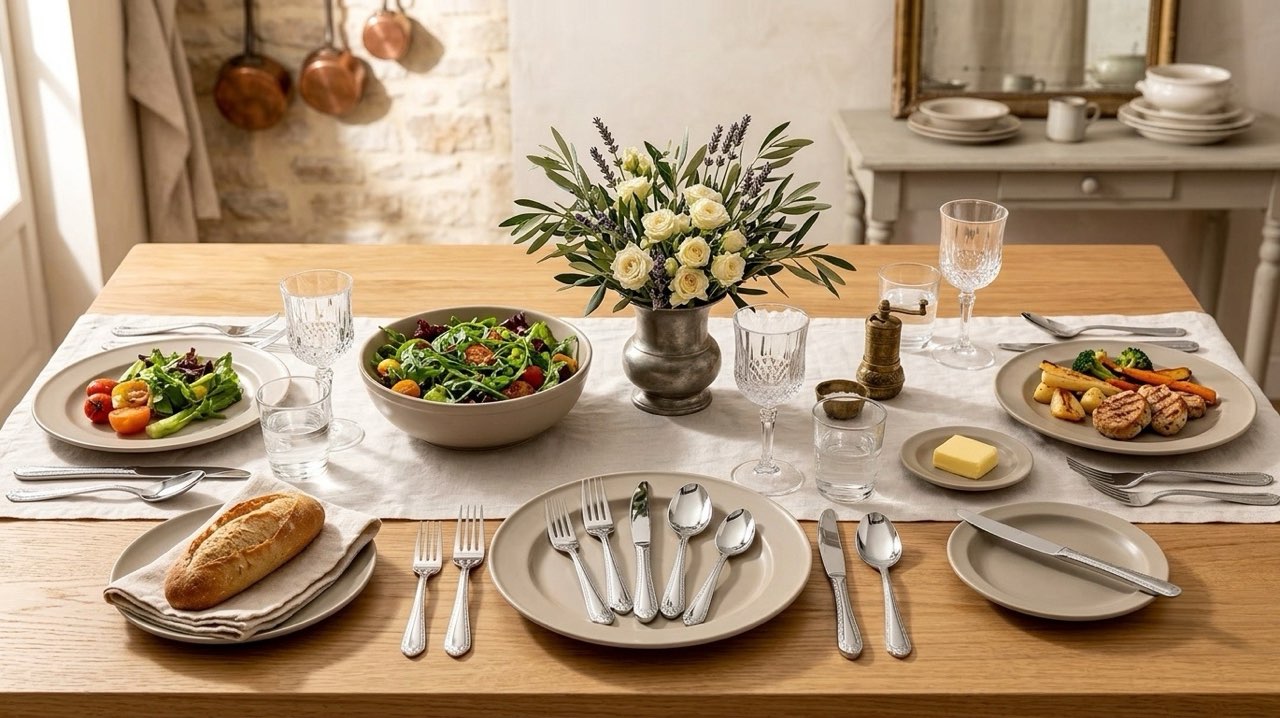
Choosing a silverware set should be simple, but the numbers can quickly become confusing.
A 20-piece flatware set sounds complete, but how many people does it serve? Is a 64-piece silverware set too much for everyday use? How many forks, spoons, knives, and serving pieces should a home actually own? And when does it make sense to buy individual flatware pieces instead of a full set?
The right answer depends on how the table is used. A small apartment, a family kitchen, a formal dining room, and a home that hosts often all need different flatware setups.
A well-planned silverware collection should support everyday meals first, then add flexibility for guests, holidays, and special occasions. It should include enough pieces to set the table comfortably, avoid constant washing between meals, and keep the table looking cohesive.
This guide breaks down how many pieces of silverware a home needs, what comes in a standard place setting, how to choose between a 20-piece and 64-piece flatware set, when to add serving utensils, and how to build a flatware collection that works for real life.
In This Guide
- The Quick Answer: How Many Pieces of Silverware Do You Need?
- What Comes in a Standard Flatware Place Setting?
- What Is Included in a 20-Piece Silverware Set?
- Who Should Choose a 20-Piece Flatware Set?
- What Is Included in a 64-Piece Silverware Set?
- Who Should Choose a 64-Piece Flatware Set?
- How Many Forks, Spoons, and Knives Should a Home Own?
- When to Buy Individual Flatware Pieces
- Serving Utensils: What Pieces Do You Actually Need?
- How to Choose Flatware for Everyday Dining and Hosting
- How to Store and Care for Stainless Steel Flatware
- Shop Barenthal Flatware Essentials
- Frequently Asked Questions
The Quick Answer: How Many Pieces of Silverware Do You Need?
Most homes should start with enough silverware for the number of people who eat at the table daily, plus a few extra place settings for guests, delayed dishwashing, and everyday convenience.
A practical flatware setup usually looks like this:
- 1–2 people: 20 pieces
- 3–4 people: 20 pieces minimum
- 4–6 people: 30–40 pieces
- 6–8 people: 40 pieces or more
- 8–12 people: 60–64 pieces
- Frequent hosts: 64 pieces plus serving utensils
- Formal dining households: 64 pieces or more
- Small households that host occasionally: 20 pieces plus individual add-on pieces
A 20-piece silverware set usually works well for four place settings. A 64-piece silverware set works well for larger households, formal dining, and hosting up to twelve people when it includes both individual place settings and serving pieces.
The strongest setup is not always the largest set. It is the set that matches the home’s daily meals, storage space, hosting habits, and table style.
What Comes in a Standard Flatware Place Setting?

A flatware place setting is the group of utensils arranged for one person at the table.
A complete five-piece place setting often includes:
This five-piece setup works for everyday meals, multi-course dinners, family gatherings, and more polished table settings.
For casual meals, a place setting may only use three pieces:
- Dinner fork
- Dinner knife
- Dinner spoon or teaspoon
For more complete dining, the five-piece setup gives the table more flexibility. The salad fork can be used for salads, appetizers, desserts, or smaller portions. The teaspoon can be used for coffee, tea, desserts, yogurt, cereal, or small bites. The dinner spoon can support soups, rice dishes, stews, desserts, and larger servings.
Five-Piece Place Setting
Dinner Fork
Used for main courses, pasta, roasted vegetables, everyday meals, and family dinners.
Salad Fork
Used for salads, appetizers, desserts, fruit, smaller plates, and layered meals.
Dinner Knife
Used for cutting soft proteins, vegetables, pancakes, breakfast foods, and general table use.
Dinner Spoon
Used for soups, stews, rice dishes, larger desserts, and sauced foods.
Teaspoon
Used for coffee, tea, desserts, yogurt, cereal, fruit, and small servings.
A five-piece place setting creates the most complete foundation for a home flatware collection.
What Is Included in a 20-Piece Silverware Set?

A 20-piece silverware set usually provides service for four people. When based on a five-piece place setting, it includes four sets of each essential utensil.
That means a 20-piece set often covers:
- 4 dinner forks
- 4 salad forks
- 4 dinner knives
- 4 dinner spoons
- 4 teaspoons
This is one of the most practical flatware sizes for small households, couples, apartments, first homes, and families of up to four people.
A 20-piece silverware set gives the table a cohesive look without requiring too much storage space. It is large enough for everyday meals, breakfast, lunch, dinner, and occasional guests, but still compact enough for smaller drawers.
A 20-Piece Silverware Set Works Well For
- Couples
- Small families
- Apartments
- First homes
- Everyday dining
- Four-person place settings
- Minimalist kitchens
- Casual hosting for up to four guests
A 20-piece set is often the best starting point for a home that wants matching flatware without building a large formal collection right away.
Who Should Choose a 20-Piece Flatware Set?
A 20-piece flatware set is ideal when the home needs a complete everyday foundation.
It works especially well for households that usually serve two to four people. It gives each person a full place setting and keeps the table consistent from seat to seat.
A 20-piece set is also useful when storage is limited. Smaller kitchens, apartment drawers, and compact dining spaces may not have room for a large 60-piece or 64-piece set. In that case, a smaller set keeps the kitchen organized while still giving the table a finished look.
Choose a 20-Piece Set When
- The household usually serves four people or fewer
- Storage space is limited
- The goal is everyday dining, not large-scale hosting
- The table needs a clean, matching foundation
- The household wants to start with one complete set
- Extra pieces can be added later if needed
A 20-piece set can also be combined with individual flatware pieces. For example, a household may start with a 20-piece set, then add extra dinner forks, dinner knives, teaspoons, or salad forks over time.
What Is Included in a 64-Piece Silverware Set?

A 64-piece silverware set is designed for larger households, more formal dining, and hosting. It usually includes enough place-setting pieces for twelve people, plus additional serving utensils.
The Barenthal Couture 64-Piece Silverware Set for 12 includes:
- 12 salad forks
- 12 dinner forks
- 12 dinner knives
- 12 dinner spoons
- 12 teaspoons
- 2 gravy ladles
- 2 pastry servers
This type of set creates a complete table for large dinners, holidays, family gatherings, and entertaining. It also keeps the table visually consistent, which matters when setting twelve place settings at once.
A 64-piece set is not only about having more utensils. It is about having the right combination of everyday pieces and serving pieces in one coordinated collection.
A 64-Piece Silverware Set Works Well For
- Larger families
- Holiday hosting
- Dinner parties
- Formal dining rooms
- Homes that serve eight to twelve people
- Households that want complete table consistency
- Hosts who need serving utensils included
- Wedding, housewarming, or long-term home upgrades
A larger silverware set makes the most sense when the home regularly sets a full table or wants a complete collection ready for both daily dining and special occasions.
Who Should Choose a 64-Piece Flatware Set?
A 64-piece flatware set is the better choice for homes that host often or want a long-term flatware collection.
It is especially useful when every place setting needs to match. During holidays, family gatherings, dinner parties, and celebrations, mismatched flatware can make the table feel less polished. A full set keeps the table cohesive from the first seat to the last.
A 64-piece set also reduces pressure on dishwashing. With more pieces available, the household does not need to wash utensils immediately between every meal.
Choose a 64-Piece Set When
- The home serves larger groups
- Hosting happens several times a year
- The dining table seats eight to twelve people
- Matching place settings are important
- Serving utensils are needed
- The household wants one complete flatware solution
- The collection is meant to last beyond daily meals
A 64-piece set is not necessary for every household, but for homes that entertain, it can make hosting feel much easier.
How Many Forks, Spoons, and Knives Should a Home Own?

The number of forks, spoons, and knives a home needs depends on how often meals are eaten at home, how often dishes are washed, and how many guests are served.
A home that eats most meals out may need fewer pieces. A home that cooks breakfast, lunch, and dinner every day needs more.
A good formula is:
Daily household size × 2 full place settings = practical everyday minimum
This gives each person enough utensils for more than one meal before washing becomes urgent.
Flatware Count by Household Size
- 1 Person: 10–15 pieces can work, but a 20-piece set gives more flexibility.
- 2 People: 20 pieces works well for daily meals and a small guest margin.
- 3–4 People: 20 pieces is the minimum; 30–40 pieces adds convenience.
- 5–6 People: 40 pieces or more keeps the drawer from running empty too quickly.
- 7–8 People: 40–60 pieces works better for family meals and guests.
- 9–12 People: 60–64 pieces gives the table a complete setup for hosting.
-
Frequent Hosts: 64 pieces plus serving utensils creates the most flexible setup.
How Many Dinner Forks Do You Need?
Dinner forks are often the most-used flatware pieces in the drawer.
They are used for main courses, pasta, vegetables, breakfast foods, lunch plates, and casual meals. Because they are used so often, many homes run out of dinner forks before they run out of knives or spoons.
Dinner Fork Count
- 1–2 people: 4–8 dinner forks
- 3–4 people: 8–12 dinner forks
- 5–6 people: 12–16 dinner forks
- 8–12 people: 12–24 dinner forks
If the household often hosts, adding extra dinner forks is one of the easiest ways to make the table more flexible.
How Many Dinner Knives Do You Need?
Dinner knives are used for table cutting, spreading butter, soft proteins, breakfast foods, and general dining.
Most homes can own the same number of dinner knives as dinner forks. This keeps place settings balanced and makes the drawer easier to organize.
Dinner Knife Count
- 1–2 people: 4–8 dinner knives
- 3–4 people: 8–12 dinner knives
- 5–6 people: 12–16 dinner knives
- 8–12 people: 12–24 dinner knives
Dinner knives are also useful when paired with steak knives. Dinner knives remain part of the everyday flatware set, while steak knives can be added when the meal requires more cutting power.
How Many Spoons Do You Need?
Most homes need both dinner spoons and teaspoons.
Dinner spoons are useful for soups, rice dishes, stews, desserts, and larger portions. Teaspoons are used more frequently for coffee, tea, yogurt, cereal, desserts, fruit, and small snacks.
Because teaspoons are used throughout the day, they often disappear into coffee mugs, lunch containers, dessert bowls, and snack plates.
Teaspoon Count
- 1–2 people: 4–8 teaspoons
- 3–4 people: 8–12 teaspoons
- 5–6 people: 12–16 teaspoons
- 8–12 people: 12–24 teaspoons
Dinner Spoon Count
- 1–2 people: 4–8 dinner spoons
- 3–4 people: 8–12 dinner spoons
- 5–6 people: 12–16 dinner spoons
- 8–12 people: 12–24 dinner spoons
If the home regularly serves soup, cereal, rice bowls, desserts, or family-style meals, extra spoons are useful.
When to Buy Individual Flatware Pieces

Individual flatware pieces are useful when a home does not need an entirely new set.
Many households lose or damage pieces over time. Sometimes the set is still beautiful, but there are not enough dinner forks, teaspoons, or knives to serve guests comfortably.
In that case, individual pieces make more sense than replacing the entire collection.
Buy Individual Flatware Pieces When
- A few pieces are missing
- The home needs extra dinner forks
- Teaspoons run out too quickly
- More knives are needed for hosting
- A 20-piece set needs to be expanded
- The table needs extra place settings
- The household wants to build slowly
- Storage space does not allow a full large set
Individual pieces are also useful for households that are building a collection gradually. Instead of buying a large set immediately, the home can start with core pieces and add more over time.
Pieces Worth Adding First
- Dinner Forks: The most practical add-on for main meals and everyday use.
- Teaspoons: Useful throughout the day for drinks, desserts, cereal, yogurt, and small servings.
- Dinner Knives: Important for complete place settings and everyday table use.
- Salad Forks: Useful for salads, appetizers, desserts, fruit, and smaller plates.
- Dinner Spoons: Helpful for soups, rice bowls, stews, desserts, and family meals.
- Iced Tea Spoons: Useful for tall glasses, iced drinks, desserts, milkshakes, parfaits, and entertaining.
A home does not need to add everything at once. Start with the pieces that run out first.
Serving Utensils: What Pieces Do You Actually Need?

Serving utensils become important when meals are shared at the table.
A standard place setting supports one person. Serving utensils support the meal itself. They help serve sauces, desserts, sides, salads, casseroles, and family-style dishes without using personal utensils.
Useful Serving Utensils
- Serving Spoon: For vegetables, rice, potatoes, pasta, sides, and casseroles.
- Slotted Serving Spoon: For foods that need liquid drained before serving.
- Serving Fork: For meats, roasted vegetables, salads, and shared dishes.
- Gravy Ladle: For sauces, gravy, dressings, and warm liquids.
- Pastry Server: For cakes, pies, tarts, desserts, quiche, and baked dishes.
- Cheese Knife: For cheese boards, appetizers, and casual entertaining.
- Cake Server: For birthdays, holidays, celebrations, and dessert service.
A smaller household may only need one or two serving pieces. A home that hosts often should own several serving utensils that match or complement the main flatware.
How to Choose Flatware for Everyday Dining and Hosting
Flatware should feel appropriate for the way the home actually uses the table.
Some households want a clean everyday set for breakfast, lunch, and dinner. Others want flatware that can move from casual meals to holidays and dinner parties. The best collection often does both.
Everyday Flatware Should Be
- Comfortable in the hand
- Easy to pair with different dinnerware
- Practical for daily meals
- Durable enough for frequent use
- Simple enough for casual dining
- Polished enough for guests
Hosting Flatware Should Be
- Consistent across place settings
- Complete enough for every guest
- Supported by serving utensils
- Easy to style with dinnerware and glassware
- Refined without feeling overly decorative
- Organized enough for fast table setting
For a home that values both everyday dining and hosting, stainless steel flatware is one of the most versatile choices. It pairs well with neutral plates, glassware, linens, wood tones, and seasonal table details.
20-Piece vs. 64-Piece Silverware Set
The choice between a 20-piece and 64-piece set comes down to table size, lifestyle, and hosting frequency.
Choose a 20-Piece Set For
- Everyday meals
- Small households
- Four-person place settings
- Apartment kitchens
- First homes
- Minimalist storage
- Simple table setups
Choose a 64-Piece Set For
- Large households
- Holiday hosting
- Dinner parties
- Formal dining
- Twelve-person place settings
- Matching table consistency
- Built-in serving pieces
A 20-piece set is the right starting point. A 64-piece set is the complete hosting solution.
How to Set a Table with a Full Flatware Place Setting

A complete place setting does not need to feel complicated.
For everyday meals, keep the table simple:
- Fork on the left.
- Knife on the right, blade facing inward.
- Spoon to the right of the knife.
- Napkin under the fork or beside the plate.
- Glass above the knife.
- Salad fork goes to the left of the dinner fork.
- Dinner fork sits closer to the plate.
- Dinner knife sits to the right of the plate.
- Dinner spoon sits to the right of the knife.
- Teaspoon can be placed outside the spoon or brought out with coffee or dessert.
Simple Rule for Placement
- Forks go on the left.
- Knives and spoons go on the right.
- Knife blades face the plate.
- Pieces used first are placed farther from the plate.
- The setting should feel balanced, not crowded.
A clean table setting helps the meal feel more thoughtful without needing heavy decoration.
How to Store and Care for Stainless Steel Flatware

Good storage and care help flatware stay organized and presentable.
Daily Storage
- Dinner forks
- Salad forks
- Dinner knives
- Dinner spoons
- Teaspoons
- Serving pieces
Keeping each type separate makes table setting faster and prevents the drawer from becoming cluttered.
After Washing
- Wash flatware after use.
- Dry pieces fully before storing.
- Avoid leaving flatware wet in the sink for long periods.
- Do not store pieces while damp.
- Keep knives separated from spoon and fork edges when possible.
To Help Maintain Shine
- Use mild dish soap.
- Avoid abrasive scrubbers.
- Dry flatware after washing to reduce water spots.
- Keep serving pieces stored separately if they are used less often.
- Check product care instructions for dishwasher use.
Flatware is used every day, but it should still be treated as part of the table presentation. Clean, organized flatware makes both daily meals and hosting feel more refined.
How to Build a Flatware Collection Over Time
A flatware collection does not need to be built all at once.
A practical path looks like this:
- Start with a 20-piece set.
- Add extra dinner forks and teaspoons.
- Add extra dinner knives if guests are common.
- Add salad forks for more complete place settings.
- Add serving utensils for hosting.
- Upgrade to a 64-piece set when the home needs a full table for larger meals.
This approach works well for households that want flexibility. It allows the table to grow with the home rather than forcing one large purchase immediately.
Build in Stages
- Stage 1: Everyday Foundation — 20-piece silverware set for four place settings.
- Stage 2: Daily Convenience — Extra teaspoons, dinner forks, and dinner knives.
- Stage 3: Hosting Flexibility — Extra place settings and salad forks.
- Stage 4: Serving Support — Serving spoon, gravy ladle, pastry server, cake server, or serving set.
- Stage 5: Complete Dining Collection — 64-piece silverware set for twelve-person hosting.
This staged approach keeps the kitchen organized while still improving the table over time.
Shop Barenthal Flatware Essentials
Barenthal Bastia 20-Piece Silverware Set, Service for 4
A polished 20-piece flatware set designed for four-person place settings, everyday meals, and small-table dining.
Shop Barenthal Bastia 20-Piece Silverware Set
Barenthal Fiori 20-Piece Silverware Set, Service for 4
A refined 20-piece silverware set for everyday dining, family meals, and simple hosting.
Shop Barenthal Fiori 20-Piece Silverware Set
Barenthal Couture 64-Piece Silverware Set for 12
A complete flatware collection for twelve place settings, formal dining, holidays, and hosting with included serving pieces.
Shop Barenthal Couture 64-Piece Silverware Set
Barenthal Couture Individual Flatware Pieces
Individual forks, knives, spoons, teaspoons, salad forks, and iced tea spoons for expanding or refreshing an existing flatware collection.
Shop Barenthal Individual Flatware Pieces
Barenthal Couture 2-Piece Serving Set
A polished serving set for gravies, desserts, pastries, and shared table moments.
Shop Barenthal Couture Serving Set

Frequently Asked Questions
How Many Pieces of Silverware Do I Need for 4 People?
For four people, a 20-piece silverware set is usually the right starting point. It typically provides four complete five-piece place settings, giving each person a dinner fork, salad fork, dinner knife, dinner spoon, and teaspoon. If the household eats at home often or hosts occasionally, extra dinner forks and teaspoons can add more daily convenience.
How Many Pieces of Silverware Do I Need for 8 People?
For eight people, 40 pieces is the minimum if each person needs a complete five-piece place setting. A larger set or extra individual pieces can make the table more flexible, especially if the home serves multiple meals before running the dishwasher or hosts guests regularly.
How Many Pieces of Silverware Do I Need for 12 People?
For twelve people, a 60-piece setup covers twelve five-piece place settings. A 64-piece silverware set adds serving pieces, making it more useful for holidays, formal dinners, family gatherings, and entertaining. This size is best for homes that want a complete table without mixing different flatware styles.
What Comes in a 20-Piece Silverware Set?
A 20-piece silverware set usually provides service for four people. It often includes four dinner forks, four salad forks, four dinner knives, four dinner spoons, and four teaspoons. This format gives each person a complete place setting for everyday dining and small gatherings.
What Comes in a 64-Piece Silverware Set?
A 64-piece silverware set usually includes twelve complete place settings plus serving utensils. The Barenthal Couture 64-Piece Silverware Set includes 12 salad forks, 12 dinner forks, 12 dinner knives, 12 dinner spoons, 12 teaspoons, 2 gravy ladles, and 2 pastry servers.
Is a 20-Piece Flatware Set Enough?
A 20-piece flatware set is enough for many couples, small families, apartments, and four-person households. It covers everyday dining well, but homes that host often or prefer fewer dishwashing cycles may need extra individual pieces or a larger set.
Is a 64-Piece Flatware Set Too Much?
A 64-piece set may be more than a small household needs for daily meals, but it is useful for hosting, holidays, large families, and formal dining. It also helps keep every place setting consistent when serving a larger group.
Which Flatware Pieces Run Out First?
Dinner forks and teaspoons usually run out first. Dinner forks are used for most meals, while teaspoons are used throughout the day for coffee, tea, cereal, yogurt, desserts, and small snacks. Adding extra sets of these pieces can improve everyday convenience.
When Should I Buy Individual Flatware Pieces?
Buy individual flatware pieces when only a few items are missing or when one type of utensil runs out faster than the rest. Individual dinner forks, teaspoons, knives, spoons, and salad forks are useful for expanding a smaller set without replacing the entire collection.
Do I Need Serving Utensils?
Serving utensils are useful when meals are shared at the table. They help serve sauces, desserts, sides, casseroles, salads, and family-style dishes. A home that hosts often should have serving spoons, ladles, pastry servers, and other pieces that match or complement the main flatware.
What Is the Difference Between Flatware and Silverware?
Flatware usually refers to forks, knives, spoons, and related dining utensils. Silverware is often used as a common everyday term for the same category, even when the pieces are made from stainless steel rather than actual silver. For modern dining, both terms are often used interchangeably.
Should All Flatware Match?
Matching flatware creates a more cohesive table, especially for hosting and formal meals. Everyday homes can mix pieces when needed, but a matching set makes the table feel more organized and refined. If pieces are missing, individual add-ons can help restore consistency without replacing the full set.
Final Thoughts
The right silverware set is not simply about the number of pieces. It is about how the home eats, hosts, stores, washes, and sets the table.
A 20-piece set creates a strong everyday foundation for four people. A 64-piece set supports larger households, holidays, and formal dining. Individual flatware pieces help replace missing utensils, expand smaller sets, and keep the table flexible.
Start with the pieces used every day. Add the pieces that run out first. Include serving utensils when meals are shared at the table. Build a collection that feels comfortable, cohesive, and ready for real life.
A better table begins with the pieces people reach for every day.
Set the table with intention. Serve with confidence. Make every meal feel complete.