
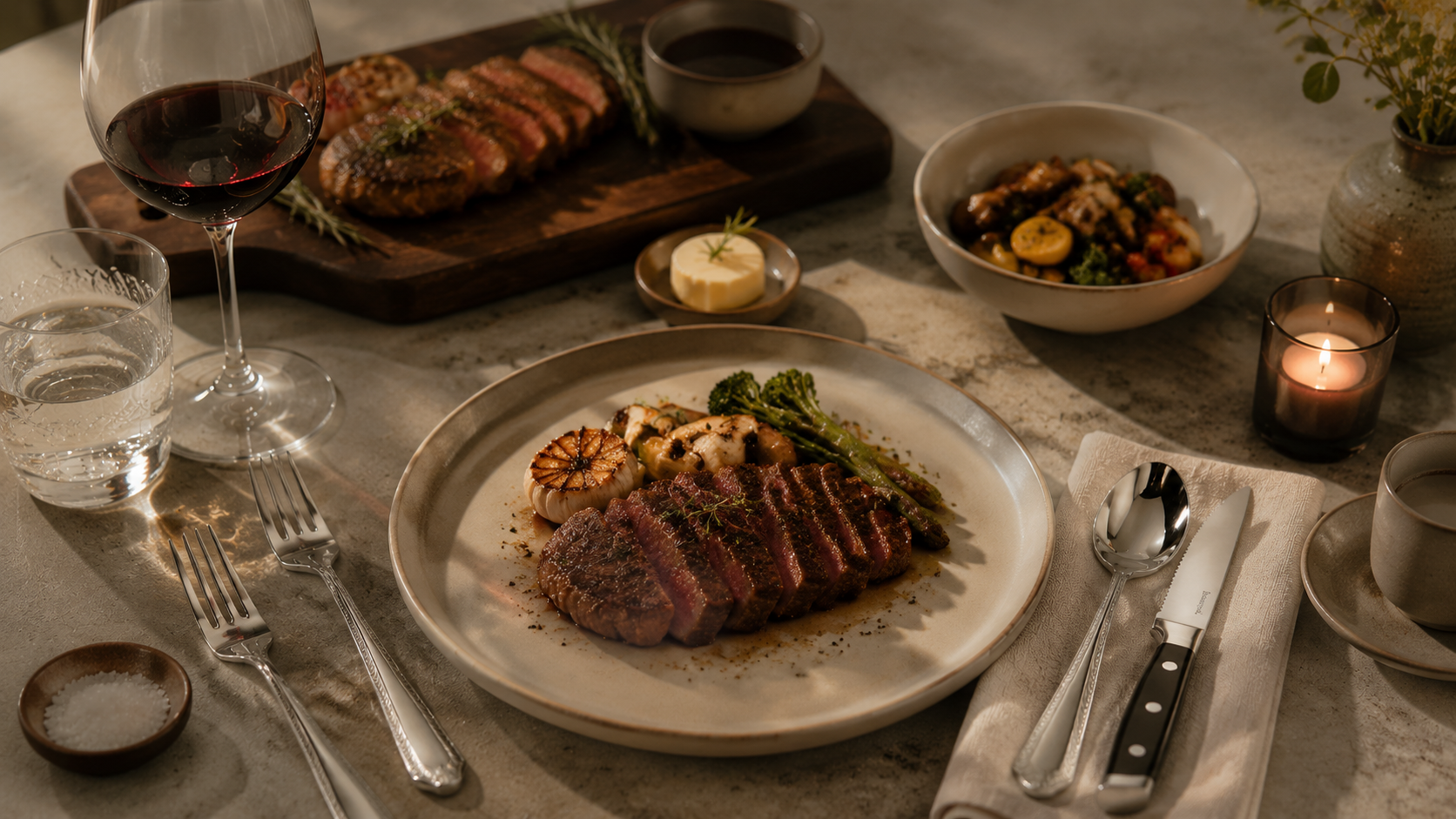
A good steak knife set does more than cut steak. It changes the way a meal feels at the table.
When a knife glides cleanly through grilled meat, roasted vegetables, crusty bread, or a thick sandwich, the dining experience feels smoother and more refined. When the knife is dull, uncomfortable, too light, too slippery, or difficult to handle, even a carefully prepared meal can feel less polished.
For home dining, the best steak knife set should balance sharpness, comfort, table presentation, storage, and everyday practicality. It should feel appropriate for a relaxed weeknight dinner, but still look elevated enough for guests, holidays, and special occasions.
This guide explains how to choose the right steak knife set for your home: serrated vs. straight-edge blades, stainless steel construction, handle comfort, set size, storage, table styling, care, and when to use steak knives instead of regular dinner knives.
In This Guide
- The Quick Answer: What Makes a Good Steak Knife Set?
- Why Steak Knives Matter at the Table
- Serrated vs. Straight-Edge Steak Knives
- Blade Material and Construction
- Handle Comfort and Balance
- How Many Steak Knives Do You Need?
- Steak Knives vs. Dinner Knives
- How to Set a Table with Steak Knives
- Storage: Knife Block, Drawer, or Wooden Chest
- How to Care for Steak Knives
- How to Pair Steak Knives with Cutting Boards and Flatware
- The Best Steak Knife Setup for Different Homes
- Shop Barenthal Knife Sets
- Frequently Asked Questions
The Quick Answer: What Makes a Good Steak Knife Set?
A good steak knife set should cut cleanly, feel comfortable in the hand, look appropriate on the table, and fit the way the household actually eats.
For most homes, the strongest steak knife set has:
- Sharp blades that can handle steak, roasted meats, sandwiches, and hearty vegetables
- Comfortable handles that feel secure during use
- A weight that feels balanced rather than flimsy or overly heavy
- A table-ready design that works with everyday flatware
- Enough knives for the number of people normally served
- Storage that protects the blades when not in use
- Care instructions that match the household’s cleaning routine
The best choice is not always the most decorative or the largest set. It is the set that supports everyday meals and hosting without making dining feel complicated.
For many homes, a 6-piece steak knife set is a practical starting point. It covers small family dinners, casual hosting, and everyday use. Larger households or frequent hosts may benefit from multiple sets or a complete knife block set that supports both kitchen prep and table service.
Why Steak Knives Matter at the Table
Steak knives are different from regular dinner knives. A dinner knife is usually designed for softer foods, spreading butter, and general table use. A steak knife is designed for more demanding cutting at the plate.
That difference matters when serving:
- Steak
- Pork chops
- Lamb chops
- Roasted chicken
- Grilled vegetables
- Thick sandwiches
- Crusty bread
- Sausages
- Roasted potatoes
- Dense casseroles or baked dishes
A well-designed steak knife makes the meal feel easier. Guests do not have to press aggressively into the plate, tear the food, or struggle through the first bite. The knife does the work more cleanly.
This is also why steak knives matter beyond steak. Any meal with firmer texture can benefit from a dedicated table knife that has more cutting power than a standard dinner knife.
Serrated vs. Straight-Edge Steak Knives

One of the biggest decisions when choosing steak knives is whether to choose serrated or straight-edge blades.
Both can work well, but they behave differently at the table.
Serrated Steak Knives

Serrated steak knives have small teeth along the blade edge. These teeth help grip the surface of food before cutting through it.
Serrated blades are especially useful for foods with a browned exterior, crust, or firmer outer layer. They can cut through steak, grilled meats, crusty bread, and thick sandwiches with less pressure than a dull dinner knife.
Serrated Steak Knives Work Well For
- Steak and grilled meats
- Pork chops
- Crusty bread
- Thick sandwiches
- Roasted vegetables
- Foods with a firm exterior
- Everyday family meals
- Casual hosting
What to Know Before Buying
Serrated knives tend to hold their cutting feel for a long time in everyday table use, but they are harder to sharpen at home than straight-edge knives. For most households, this is not a major issue because steak knives are used at the table rather than for heavy kitchen prep.
For home dining, serrated steak knives are often the most practical choice because they are versatile and easy to use across different meals.
Straight-Edge Steak Knives
Straight-edge steak knives have a smooth blade edge. They can create very clean slices when properly sharpened, which some people prefer for fine dining or more precise cutting.
The tradeoff is maintenance. Straight-edge blades usually need more regular sharpening to keep their performance. If they become dull, they can drag through food instead of slicing cleanly.
Straight-Edge Steak Knives Work Well For
- Clean, precise slicing
- Formal dining settings
- Users comfortable with knife maintenance
- Meals where presentation is especially important
What to Know Before Buying
Straight-edge steak knives can feel elegant, but they require more care. For households that do not sharpen knives regularly, serrated steak knives are often easier to maintain for everyday dining.
Blade Material and Construction
Blade material affects sharpness, appearance, durability, care, and how the knife feels during use.
For home dining, stainless steel is one of the most common steak knife materials because it offers a clean look and fits well with modern flatware and table settings.
When comparing steak knives, pay attention to:
- Blade sharpness
- Edge type
- Steel type
- Handle construction
- Blade thickness
- Weight distribution
- How the blade connects to the handle
- Care instructions
A steak knife should feel strong enough for regular use but not so heavy that it feels uncomfortable at the table.
Stainless Steel Steak Knives
Stainless steel steak knives pair naturally with stainless steel flatware, neutral dinnerware, glassware, and modern table settings. They can look polished without feeling overly formal.
For a cohesive table, stainless steel steak knives are especially useful because they visually connect with forks, spoons, serving pieces, and other tableware.
Stainless Steel Steak Knives Work Well For
- Everyday dinners
- Guest meals
- Modern table settings
- Stainless steel flatware pairings
- Families that want a cohesive table
- Hosts who want table-ready knives
A polished stainless steel finish can make the table feel more complete, especially when paired with matching flatware and clean dinnerware.
Full-Tang and Handle Construction
The way a steak knife is built affects how it feels in the hand.
A full-tang knife means the blade metal extends into or through the handle. This type of construction can create a more substantial, balanced feel. A triple-riveted handle adds a traditional look and can help the knife feel secure.
Not every household needs professional-level knife construction at the table, but a steak knife should still feel stable, comfortable, and controlled.
Handle Details to Check
- Does the handle feel secure?
- Is the grip comfortable?
- Does the knife feel balanced?
- Is the handle too thin or too bulky?
- Does the finish match the table style?
- Is the knife easy to hold during a full meal?
Comfort matters because steak knives are used while seated. The knife should feel natural in the hand and easy to control on the plate.
Handle Comfort and Balance

A steak knife should not feel awkward, slippery, or poorly balanced. If the handle is uncomfortable, the knife becomes distracting during the meal.
A good table knife should feel steady without requiring a tight grip. The handle should support the hand, while the blade should cut without excessive pressure.
A Comfortable Steak Knife Should Feel
- Secure in the hand
- Balanced from handle to blade
- Easy to control while seated
- Substantial but not too heavy
- Smooth along the handle edges
- Comfortable for both everyday dining and hosting
If the knife feels too light, it may feel cheap or unstable. If it feels too heavy, it may feel tiring or too formal for everyday meals. The best balance is somewhere in the middle: strong, controlled, and comfortable.
How Many Steak Knives Do You Need?
The right number of steak knives depends on household size and hosting habits.
Set of 4
A 4-piece steak knife set works for couples, small households, and homes that rarely host. It is compact, easy to store, and enough for simple everyday dinners.
Set of 6
A 6-piece steak knife set is one of the most practical sizes for home dining. It works for families, small dinner parties, and occasional guests. It also gives a four-person household a few extra pieces when needed.
Set of 8
An 8-piece steak knife setup works well for larger families or households that host more often. It gives the table more flexibility for weekend dinners, holiday meals, and casual gatherings.
Set of 12
A 12-piece setup is useful for frequent entertainers or homes that host large meals. It also makes sense when steak knives are used regularly for more than steak, such as sandwiches, grilled foods, and family-style dinners.
Simple Rule
Choose enough steak knives for the largest group you realistically serve, not the largest group you imagine hosting once a year.
For many homes, six steak knives are enough. For frequent hosts, eight to twelve can make table setting easier.
Steak Knives vs. Dinner Knives
A dinner knife and a steak knife are not the same tool.
A dinner knife is part of the standard flatware setting. It is usually used for spreading butter, cutting soft foods, and general table tasks.
A steak knife is brought out when the food requires more cutting power.
Use a Dinner Knife For
- Soft vegetables
- Fish
- Pasta bakes
- Eggs
- Pancakes
- Soft casseroles
- Spreading butter
- General table use
Use a Steak Knife For
- Steak
- Pork chops
- Lamb
- Roasted meats
- Grilled chicken
- Thick sandwiches
- Crusty bread
- Firm roasted vegetables
Steak knives do not need to replace dinner knives. They work alongside them. For a polished table, place dinner knives as part of the flatware setting and bring steak knives when the meal calls for them.
How to Set a Table with Steak Knives

Steak knives should feel like part of the table, not an afterthought.
For casual meals, a steak knife can replace the dinner knife when the meal requires stronger cutting. For a more layered table, the steak knife can be placed to the right of the dinner knife or brought out with the main course.
Simple Everyday Setting
- Place the fork on the left side of the plate.
- Place the steak knife on the right side of the plate, blade facing inward.
- Place the spoon to the right of the knife if needed.
- Keep the setting clean and uncluttered.
Hosting Setting
- Place the dinner fork on the left.
- Place the dinner knife on the right.
- Add the steak knife outside the dinner knife if it will be used for the main course.
- Keep the blade facing the plate.
- Make sure every place setting has the same arrangement.
Why Blade Direction Matters
The blade should face inward toward the plate. This is the standard visual direction for table knives and creates a safer, more polished place setting.
When the table is set consistently, even a simple meal feels more intentional.
Storage: Knife Block, Drawer, or Wooden Chest

Steak knives should be stored in a way that protects the blades and keeps the kitchen organized.
Wooden Storage Chest
A wooden storage chest works especially well for steak knives used for hosting. It keeps the set together, protects the knives, and makes the set easy to bring out for dinner parties or special meals.
A storage chest can also make a steak knife set feel more giftable and presentation-ready.
Knife Block
A knife block is useful when steak knives are part of a larger kitchen knife set. It keeps prep knives and table knives organized in one place and allows quick access during cooking.
A block set works well for homes that want a complete kitchen knife system instead of separate pieces stored in different drawers.
Drawer Storage
Drawer storage can work if the knives are protected. Use a drawer organizer, blade guard, or dedicated knife tray. Do not let steak knives move freely in a drawer, because this can damage the edges and create a safety issue when reaching inside.
Storage Checklist
- Keep the set together
- Protect blade edges
- Store knives fully dry
- Avoid loose drawer storage
- Keep sharp edges away from children
- Use a chest, block, tray, or blade guard
Good storage helps preserve both the knives and the kitchen routine.
How to Care for Steak Knives
Steak knives should be cleaned and dried with care. Even when a product is compatible with dishwasher cleaning, handwashing and prompt drying can help maintain the appearance of stainless steel and reduce spotting.
After Every Use
- Rinse off food residue.
- Wash with warm water and mild dish soap.
- Use a soft sponge or cloth.
- Dry immediately with a clean towel.
- Store only after the knives are fully dry.
Do not leave steak knives soaking in water. Do not leave them wet in the sink. Do not store them while damp.
Avoid
- Harsh scrubbers
- Long soaking
- Leaving acidic food residue on the blade
- Storing knives wet
- Loose storage in a crowded drawer
- Cutting directly on ceramic plates more than necessary
A steak knife is used at the table, but it is still a sharp tool. Treating it with care helps preserve both appearance and performance.
How to Pair Steak Knives with Cutting Boards and Flatware

Steak knives are part of a larger dining system. They work best when they connect visually and functionally with the rest of the table.
Pair with a Cutting Board
A cutting board supports the prep stage before the meal reaches the table. It can also be used to serve bread, sliced steak, roasted vegetables, or appetizers.
For steak dinners and hosting, a cutting board can help with:
- Slicing cooked meat before serving
- Resting and presenting bread
- Arranging appetizers
- Serving grilled vegetables
- Creating a shared centerpiece
A clean, structured cutting board makes the movement from kitchen to table feel more polished.
Pair with Stainless Steel Flatware
If the steak knives have a stainless steel finish, pair them with stainless steel flatware for a cohesive table. The finishes do not need to match perfectly, but they should feel visually connected.
A table with polished flatware, balanced steak knives, neutral plates, and clear glassware feels refined without needing heavy decoration.
Pair with Simple Dinnerware
Steak knives often bring a stronger visual presence to the table. Keep the rest of the table clean and calm:
- Neutral plates
- Clear glassware
- Linen or cotton napkins
- One serving board
- One natural centerpiece
- Minimal extra decoration
The goal is not to create a formal steakhouse setting. The goal is to make home dining feel more complete.
The Best Steak Knife Setup for Different Homes

For Everyday Family Dinners
- Use a 6-piece serrated steak knife set.
- Keep the knives close to the flatware drawer or dining area.
- Pair with simple stainless steel flatware and durable dinnerware.
This setup works well for weeknight dinners, grilled meals, and casual family tables.
For Small Apartments
- Use a compact 4-piece or 6-piece set with protective storage.
- Avoid loose drawer storage.
- Choose knives that can be used for multiple meals, not only steak.
A small kitchen benefits from tools that are easy to store and easy to bring to the table.
For Frequent Hosts
- Use at least six to eight steak knives.
- Choose a storage chest or block to keep the set organized.
- Pair with matching flatware and a serving board.
Hosting feels smoother when every guest has the same knife and the table looks consistent.
For Gift Giving
Choose a steak knife set with polished presentation, durable storage, and a design that works across different table styles.
A wooden storage chest can make the set feel more complete as a housewarming, wedding, holiday, or host gift.
For Complete Kitchen Prep
Use a full knife block set for prep tasks and a steak knife set for table service.
The block supports chopping, slicing, and meal preparation. The steak knives support the dining experience once the meal is served.
Shop Barenthal Knife Sets
Barenthal 6-Piece Classic Serrated Steak Knife Set, German Stainless Steel
A polished serrated steak knife set for everyday dinners, grilled meals, and hosting.
Shop Barenthal Classic Serrated Steak Knives
Barenthal 6-Piece Steak Knife Set with Wooden Storage Chest
A table-ready steak knife set with a wooden storage chest for organized storage and gifting.
Shop Barenthal Steak Knives with Wooden Chest
Barenthal 17-Piece Knife Set with Block
A complete kitchen knife block set for meal prep, slicing, chopping, and everyday cooking.
Shop Barenthal 17-Piece Knife Set
Barenthal Cutting Boards
A practical prep and serving surface to pair with steak knives, bread, appetizers, and everyday meals.
Shop Barenthal Cutting Boards
Barenthal Stainless Steel Flatware
Polished flatware for cohesive place settings that pair naturally with stainless steel steak knives.
Shop Barenthal Silverware Sets

Frequently Asked Questions
What Is the Best Steak Knife Set for Home Dining?
The best steak knife set for home dining should feel sharp, balanced, comfortable, and table-ready. For most households, a 6-piece serrated stainless steel steak knife set is a practical choice because it works for family dinners, grilled meats, thick sandwiches, roasted vegetables, and casual hosting. The set should also include safe storage and care instructions that match the home’s routine.
Are Serrated Steak Knives Better Than Straight-Edge Steak Knives?
Serrated steak knives are often more practical for everyday home dining because the small teeth help grip and cut through steak, crusty bread, grilled meats, and firm foods. Straight-edge steak knives can create clean slices when sharp, but they usually require more regular maintenance. For most homes, serrated knives offer easier everyday performance.
How Many Steak Knives Should I Own?
Most homes should own enough steak knives for the largest group they regularly serve. A 4-piece set works for couples or small households. A 6-piece set works for families and small gatherings. Homes that host often may benefit from eight or more steak knives so every guest has a matching place setting.
Can I Use Steak Knives Every Day?
Yes. Steak knives can be used for more than steak. They are useful for pork chops, grilled chicken, thick sandwiches, crusty bread, roasted vegetables, and other foods that need more cutting power than a standard dinner knife. For daily use, choose knives that feel comfortable, balanced, and easy to clean.
Should Steak Knives Match My Flatware?
They do not need to match perfectly, but they should feel visually connected to the rest of the table. Stainless steel steak knives pair well with stainless steel flatware because the finishes create a cohesive look. Matching materials, simple lines, and a calm table setting help the meal feel more polished.
What Is the Best Way to Store Steak Knives?
The best storage method protects the blades and keeps the set organized. A wooden chest works well for steak knives used during hosting. A knife block works well when steak knives are part of a larger kitchen set. Drawer storage can work if the knives are placed in a tray or protected with blade guards.
Should Steak Knives Go in the Dishwasher?
Always follow the product’s care instructions. Even when a knife is compatible with dishwasher cleaning, handwashing and immediate drying can help preserve the finish and reduce water spots. Do not leave steak knives soaking in water or stored while damp.
What Is the Difference Between a Dinner Knife and a Steak Knife?
A dinner knife is part of the everyday flatware setting and is used for soft foods, spreading, and general table tasks. A steak knife has more cutting power and is used for steak, grilled meats, chops, thick sandwiches, crusty bread, and other firmer foods. The two knives serve different roles at the table.
Are Steak Knives a Good Gift?
Yes. A quality steak knife set can be a thoughtful gift for housewarmings, weddings, holidays, hosts, and people who enjoy cooking or entertaining. A set with organized storage, such as a wooden chest, feels especially giftable because it is practical, polished, and easy to present.
How Do I Set a Table with Steak Knives?
Place the steak knife on the right side of the plate with the blade facing inward. For casual meals, the steak knife can replace the dinner knife. For a more layered table, use the dinner knife as part of the main flatware setting and add the steak knife for the main course. Keep every place setting consistent.
Final Thoughts
A steak knife set is a small detail that can change the entire dining experience.
The right knives make meals easier to enjoy. They cut cleanly, feel comfortable, sit naturally beside flatware, and make the table look more complete. Whether used for steak, grilled vegetables, sandwiches, bread, or a dinner with guests, a well-chosen steak knife set brings both function and refinement to the table.
Choose knives that fit the way the household actually eats. Store them properly. Care for them consistently. Pair them with simple flatware, a clean cutting board, and a table setting that feels polished without being overdone.
A better dining experience often begins with the tools people notice only when they work beautifully.
Set the table with confidence. Serve with ease. Make every meal feel considered.