
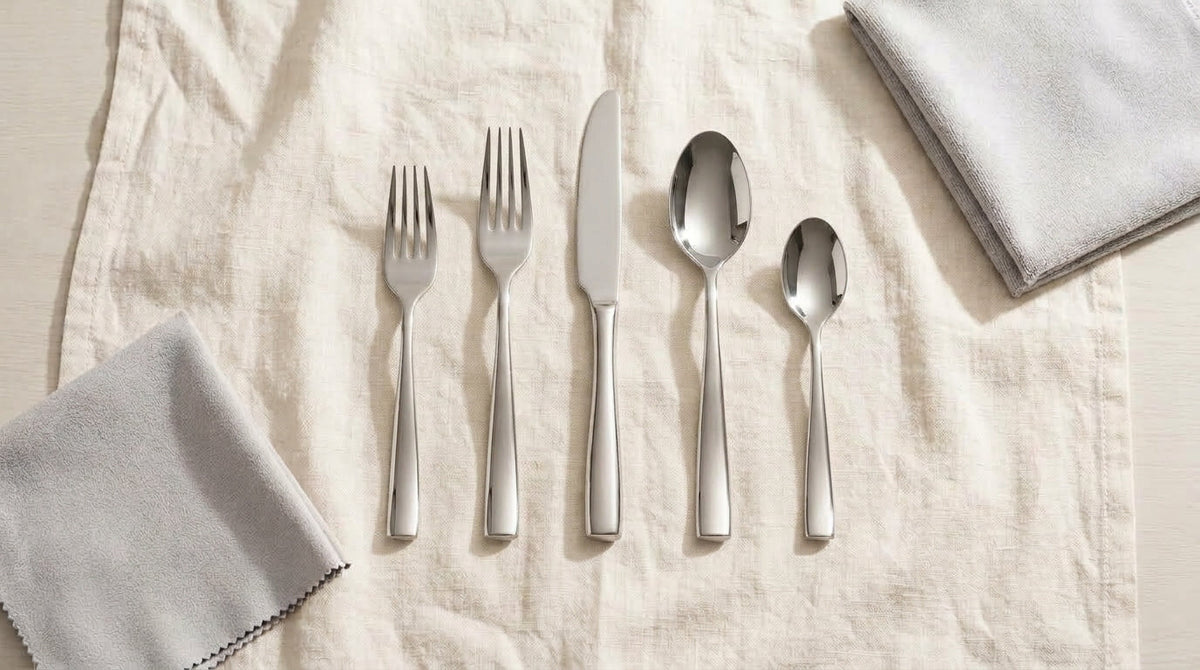
You open the flatware drawer before dinner and notice that the spoons look cloudy, a knife has a small orange mark, and the forks no longer look as bright as they did when new. Does the set need replacing—or does the cleaning routine need attention?
To clean stainless steel flatware, begin with warm water, mild dish soap, and a soft cloth or nonabrasive sponge. Rinse thoroughly and dry each piece promptly. Barenthal’s Couture care instructions also specify avoiding abrasive scrubbers, metal wool, and citrus-scented dishwasher detergents. 1
Before treating a stubborn mark, identify the material and finish. This guide focuses on uncoated stainless steel forks, spoons, and table knives. Silver-plated pieces, sterling silver, decorative coatings, and attached handles can require different care. Follow the instructions for the exact product rather than assuming that every item called “silverware” needs the same treatment.
Start Here: What Kind of Mark Are You Seeing?
Use this table to choose a starting point, not to make a diagnosis from color alone. Inspect the utensil after washing and drying; residue and actual surface damage can look similar when a piece is still wet.
| What you notice | What it may indicate | First action |
|---|---|---|
| Pale spots or outlines of dried droplets | Water marks or mineral deposits | Wash, rinse, and towel-dry; check the dishwasher routine if marks return. |
| A cloudy or streaky surface | Residue, deposits, or incomplete rinsing | Hand-wash one piece and compare it with the rest of the load. |
| Small orange or brown marks | Surface rust deposits or corrosion | Clean gently, then inspect the flatware and dishwasher before further treatment. |
| Fine lines that remain after cleaning | Scratches rather than a removable film | Stop escalating the cleaning method; scrubbing is not a repair. |
| Small holes, rough areas, or flaking | Possible pitting or finish damage | Set the piece aside and contact the manufacturer. |

Water marks, fine scratches, and pitting require different responses. Cleaning can remove some deposits, but it does not rebuild metal lost to pitting. 7
How to Wash Stainless Steel Flatware by Hand
Hand-washing one affected piece is a useful first check before changing the care routine for the whole set.
1. Remove food residue
Clear away food and wash after use. Give particular attention to pieces exposed to salty or acidic foods instead of leaving residue on them for an extended period. 8
2. Use mild soap and a soft cleaning tool
Wash in warm water with mild dish soap. Use a soft cloth or nonabrasive sponge, cleaning the front, back, handle, and spaces between fork tines. Do not leave the pieces soaking overnight.
3. Rinse thoroughly
Remove all soap before drying. Cleaning residue left behind can make it difficult to judge whether the original mark is gone.
4. Dry each piece
Use a clean, soft towel rather than leaving droplets on the surface. Handle table knives individually and carefully; do not hide sharp utensils in a sink full of water. 2
5. Compare the result
Look at the dry piece under normal light. If the cloudiness disappears, concentrate on rinsing and drying. If a colored mark or rough area remains, move to the relevant section below instead of immediately using a stronger product.

How to Deal with Water Spots and Cloudy Flatware
Start by buffing a clean, dry piece gently with a dry microfiber cloth. Some water marks can be removed this way. If the mark remains, wash and dry the piece before deciding that it needs a specialist cleaner. 7
Next, look beyond the utensil. Are glasses cloudy too? Are plates streaked? Does the problem affect the entire load or only tightly stacked spoons? These observations give you a more useful troubleshooting starting point than repeatedly polishing the same fork.
Check water hardness and appliance settings
Hard water contains more dissolved minerals, which can affect washing results. Find the local water hardness through your water supplier. If your dishwasher has an adjustable water softener, set it according to that model’s manual. Do not copy another machine’s setting or add dishwasher salt to an appliance without the appropriate system. 5
Check whether the cycle is finishing the job
Incorrect loading, unsuitable detergent, insufficient rinse aid, dirty filters, and a cycle without an effective drying stage can contribute to disappointing results. Follow the appliance manual when adjusting these variables. Change one setting at a time so you can see what actually helps. 4
If mineral deposits remain, ask the flatware manufacturer which cleaner is compatible with the finish. A cleaner intended for a dishwasher interior is not automatically suitable for a polished fork or spoon.
How to Handle Rust Marks on Stainless Steel Flatware
Stainless steel resists corrosion, but it is not completely rustproof. Prolonged exposure to certain food residues or unsuitable cleaning chemicals can affect its protective surface. Brown marks may also come from rust particles elsewhere in a dishwasher, including corroded utensils or damaged rack coatings. Their presence alone does not establish the cause. 3
Start with the least aggressive method
Wash, rinse, and dry the affected piece first. If the mark remains, use a specialist cleaner only when its label covers stainless steel flatware and the flatware manufacturer permits it for that finish.
Follow the cleaner’s application time, rinsing, and handling instructions exactly. Work on one piece first rather than treating the entire set. Do not assume that longer contact or heavier pressure will improve the result. Thoroughly remove cleaning residue before the utensil returns to use. 6
Investigate marks that keep returning
Inspect the dishwasher for corroding tools and exposed metal on damaged racks. Resolve the source rather than repeatedly cleaning deposits from the flatware. Appliance or plumbing support may be needed if the issue persists. 3
If a cleaned area has visible pits, a rough edge, or continuing deterioration, stop home treatment and contact the manufacturer. Do not treat a damaged surface as a simple cosmetic spot.
Dishwasher Care: The Checks That Matter

First, confirm that the specific flatware product is dishwasher safe. A stainless steel blade does not tell you whether its handle, coating, or assembled construction can tolerate the same cleaning method.
Loading and detergent
Follow the dishwasher’s loading instructions, including safe knife placement. Avoid overcrowding. Use dishwasher detergent—not hand-dishwashing liquid—and a compatible dose and cycle. Some tablets do not dissolve fully in very short cycles. 4
Drying and storage
After the cycle, let utensils become safe to handle, then dry any remaining moisture before putting them away. For recurring drying problems, check rinse aid and appliance maintenance rather than relying on a progressively stronger detergent. 4
Barenthal Couture care requirements
The current care instructions for the Couture 64-Piece Silverware Set for 12 identify it as dishwasher safe and specify avoiding citrus-scented detergents. They also call for mild soap and warm water before first use, no abrasive scrubbers or metal wool, and thorough drying after washing. Use these product instructions as the starting point for Couture care—not a generic cleaning hack. 1
Cleaning Shortcuts to Avoid
Overnight vinegar or lemon soaking
Do not make prolonged acid soaking the default treatment for cloudy flatware. Noritake’s stainless steel care guidance cautions against extended exposure to vinegar, chlorine, and salt solutions. Persistent marks call for a product-compatible method, not an improvised stronger soak. 2
Steel wool and abrasive scrubbing
Do not scrub a mirror finish with metal wool or abrasive pads. Barenthal’s Couture instructions explicitly exclude these tools. More pressure is not a substitute for identifying the mark correctly. 1
Bleach and cleaners intended for another surface
Avoid chlorine bleach on stainless steel flatware. Choose cleaning products by their stated compatibility, not simply because the bottle says “metal cleaner.” A product intended for another material or finish should not be transferred to cutlery without checking its directions. 2
Trying to polish away scratches
Fine scratches can develop through everyday use. They are different from a film sitting on the surface. Repeated aggressive treatment can change the appearance of a polished piece without solving the underlying issue. 7
A Practical Routine for Everyday Use and Hosting

The easiest routine is one that fits the way your household already eats and washes dishes. There is no need to add a complicated polishing session after every meal.
After a meal
Clear the table, separate pieces that need hand care, and deal with food residue before putting everything aside. After washing, return dry utensils to a clean organizer rather than a damp drawer. Keep less frequently used serving pieces together so they are easy to find. 8
Before guests arrive
Count the pieces needed for the actual menu. Check the flatware while setting the table—not when the food is ready. Set aside any questionable piece for attention and keep a few clean extras accessible.
For planning quantities, use Barenthal’s How Many Pieces of Silverware Do You Need? guide. For the wider table and serving setup, use the Holiday Hosting Checklist. Cleaning and guest-count planning are separate jobs; handling both early keeps the last hour focused on the meal.
When only one type of utensil runs short
Check the drawer before buying another full collection. You may need more teaspoons, a replacement fork, or additional matching pieces rather than a new set. Make that decision based on what is missing or damaged—not on a removable water mark.
When to Contact Barenthal or Replace a Piece
Set aside flatware with a loose handle, sharp damage, visible pitting, flaking finish, or deterioration that continues after appropriate cleaning. A customer-service review is a better next step than repeated experimental treatments.
When contacting Barenthal, provide the collection name, order information if available, a clear photo of the dry piece, and a short description of the detergent and cleaning method used. Note whether the same marks appear on other items in the dishwasher. That information helps distinguish a product-specific concern from a wider cleaning problem.
Ordinary cleaning should not be expected to repair deep damage. At the same time, a few spots do not automatically mean that the entire collection needs replacing.
Contact Barenthal About Product Care
Complete Your Couture Flatware Collection
Replace or add only the pieces your table actually needs. Check the collection name, shape, and dimensions before combining new pieces with an existing set.
Couture Dinner Forks, Set of 4
Four matching Couture dinner forks for replacing missing pieces or adding to an existing collection. This pack contains four forks—not four complete place settings. 9

Couture Teaspoons, Set of 4
Four matching Couture teaspoons for expanding a collection without purchasing a full flatware set. This pack contains four teaspoons. 10

Barenthal Silverware Collection
Browse complete sets and individual pieces, then choose by collection and required piece count.
Frequently Asked Questions
What is the simplest way to clean stainless steel flatware?
Start with mild dish soap, warm water, and a soft cloth or nonabrasive sponge. Rinse thoroughly and dry promptly. Check the product’s instructions before adding a cleaner or using the dishwasher. The first step is routine washing, not aggressive polishing. 1
Can dishwasher-safe flatware still develop marks?
Yes. Dishwasher compatibility does not eliminate the effects of detergent choice, loading, water conditions, or incomplete drying. Treat the mark as a troubleshooting question: inspect a clean, dry piece and check how the rest of the load looks before changing the cleaning method. 4
Why do the knives look different from the forks and spoons?
Knife blades may use a different stainless steel formulation from forks and spoons to support their cutting function. Pieces in one setting therefore do not necessarily react identically to the same washing conditions. Check the individual product specifications rather than assuming every utensil is made from the same steel. 8
Is every orange mark a sign that the flatware itself is corroding?
No. Rust deposits can originate elsewhere in a dishwasher, but corrosion of the utensil is also possible. Appearance alone cannot distinguish the two reliably. Clean gently, inspect the dry surface, and investigate recurring marks. 3
Should I buy a new set because the current one looks cloudy?
Not as the first step. Wash and dry a representative piece, review the care instructions, and check the dishwasher routine. A new purchase makes more sense when pieces are missing, damaged beyond appropriate repair, or insufficient for the number of people you regularly serve.
Can I use these methods on silver-plated or colored flatware?
Do not assume so. Confirm the material, finish, and handle construction, then follow that product’s instructions before using a stain remover or polishing product.
Keep Good Flatware in Everyday Use
A useful care routine begins with observation: identify the piece, wash gently, dry it, and see what remains. Water marks, deposits, scratches, and damage are not interchangeable problems.
Look after the collection you already own, investigate recurring marks instead of repeatedly masking them, and add matching pieces only when the table needs them. The aim is not a drawer that stays untouched. It is flatware that remains ready for the meals you share every day.
Care References
This guide combines the published product instructions and care resources below. Instructions for the exact product and cleaning agent take precedence; third-party care resources do not constitute approval of a particular treatment for every Barenthal item.