
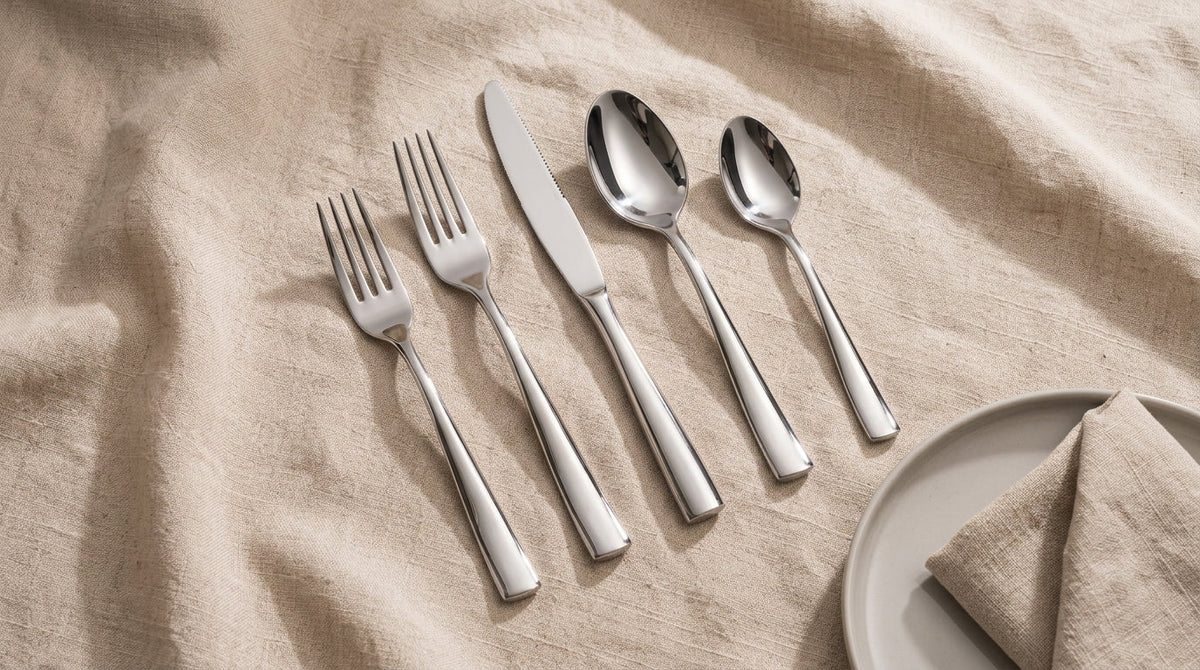
Two flatware sets can look almost identical online. Both have a silver finish, both include forks and spoons, and both are described as stainless steel. Then you notice the numbers: one is marked 18/10, another 18/0, and a third 18/8.
The basic distinction is composition: the first number describes chromium content and the second describes nickel content. In common flatware labeling, 18/10 indicates about 18% chromium and 10% nickel; 18/0 indicates about 18% chromium without an intentional nickel addition. These are material descriptions—not scores out of ten. [1] [4]
The label is useful, but it does not tell you everything about the finished fork, spoon, or knife. It does not specify handle thickness, weight, comfort, the number of usable place settings, or the care requirements for every component.
Use this guide to understand the numbers, compare the details that matter at the table, and choose a collection without paying for assumptions.
What Do 18/10, 18/8, and 18/0 Mean?
Read the two numbers separately. The first refers to chromium, not the percentage of all stainless steel in the item. The second refers to nickel—not silver. Stainless steel is an iron-based alloy containing chromium and, depending on the grade, other elements. [1] [2]
The figures are a convenient way to discuss composition, but they are not a complete specification. A product-specific material declaration gives more information than a short retail label.
| Flatware label | Common composition shorthand | What to take from it |
|---|---|---|
| 18/10 | About 18% chromium and 10% nickel | A chromium-nickel stainless steel designation. Still check the finished design and product instructions. |
| 18/8 | About 18% chromium and 8% nickel | Another chromium-nickel designation; the “18-8” description is also used for a broader group of steels. |
| 18/0 | About 18% chromium, without an intentional nickel addition | A different stainless steel composition, not a statement that the product is fake or unusable. |

The table explains common labels, not a laboratory analysis of any particular product. Outokumpu describes “18-8” as an approximate composition designation; specific alloy grades contain more detail than the two-number shorthand. [1] [3] [4]
For shopping, the useful next question is: Which components does the material description cover? A statement about a complete set does not necessarily explain the construction of every knife blade and handle.
Does 18/10 Automatically Mean Better Flatware?
No. It identifies a material choice, not a complete quality assessment.
Corrosion resistance is not just a nickel score
Chromium allows stainless steel to develop a thin protective surface film. Stainless steel can nevertheless corrode when its composition is unsuitable for the conditions or its protective surface is compromised. No retail ratio makes a utensil immune to every cleaning or storage environment. [2]
Nickel-containing austenitic steels offer a useful combination of corrosion resistance and formability. But nickel is not the only variable: Outokumpu also makes ferritic steels with little or no nickel across a range of corrosion-resistance levels. The practical lesson is to avoid predicting an entire product’s performance from the second number alone. [3] [4]
The same material can feel different in the hand
Two 18/10 forks can have different thicknesses, lengths, contours, and weight distribution. Manufacturers offer different gauges within the same 18/10 designation, so the material number cannot tell you whether a particular handle will feel light or substantial. [6]
Ask about dimensions or weight when those details matter to you. A larger number in the steel description is not a substitute for a shape you enjoy using.
Material and finish are separate decisions
Read the material line and the finish line separately. “18/10 stainless steel” describes composition; “mirror finish” describes the surface presentation. Barenthal’s Couture listing, for example, identifies both rather than treating them as the same feature. [8]
Compare the finish under consistent lighting where possible. Do not assume that a bright product photograph demonstrates a higher nickel content, better scratch resistance, or a longer service life.
Why Can the Knives Use a Different Stainless Steel?
A fork needs to hold food. A spoon needs a comfortable bowl. A knife blade also needs cutting performance.
Knife makers can use hardenable martensitic stainless steels for cutting utensils. Their properties depend on composition and heat treatment, and their corrosion behavior can also be affected by surface finish. A different blade alloy can therefore be a purposeful construction choice rather than a downgrade. [5]
This distinction is important when shopping for a set advertised as 18/10. Read any separate blade specification instead of assuming that the forks, spoons, blade, and handle all share one composition.
Do not assign a blade grade that the manufacturer has not stated. If a product description is only set-level, ask for clarification when the exact knife alloy matters to your purchase. A general explanation of knife metallurgy is not a certificate for a specific Barenthal blade.

Can a Magnet Tell You Whether Flatware Is Good Quality?
A magnet is not a quality certificate.
Ferritic and martensitic stainless steels are magnetic. Austenitic steels are nonmagnetic in the solution-annealed condition, but some can develop a magnetic response after cold working during manufacturing. [2] [3]
Consequently, “a magnet sticks” does not, by itself, mean that a utensil is poor quality or not stainless steel. Nor does the absence of attraction establish a precise nickel percentage.
Do not approve or reject a collection on that test alone. Use the manufacturer’s material information, inspect the construction, and ask for product-specific documentation if composition needs to be verified.
Five Details to Check Before Buying a Flatware Set
The steel label is one line in the decision. These five checks turn it into a practical purchase.
1. Identify exactly what you are buying
Record the collection name, material statement, finish, selected pack size, and included utensils. Separate facts printed on the product page from impressions created by photographs.
A simple comparison note is enough: “Material stated; knife details stated or not stated; dimensions available or not available; pack selected; care instructions checked.” Leave a field unanswered rather than filling it with an assumption.
2. Examine the parts that touch your hand and mouth

Look for close views of handle edges, fork tines, and spoon bowls. When a sample or a piece you already own is available, assess it in the way you actually eat: hold the fork, lift the spoon, and rest the handle against your fingers.
Focus on personal fit. Does the handle feel comfortable without a tight grip? Is the spoon bowl a size you like? Does the dinner fork suit your plates? These questions are more useful than choosing the heaviest item by default.
Do not deliberately bend a utensil to test it. Use published measurements and normal handling instead.
3. Count place settings—not just total pieces
Use the itemized contents. In a five-piece setting, four guests need 20 personal utensils; eight need 40; twelve need 60. These totals follow from five utensils per person and exclude shared serving tools.
Serving pieces add to the box count without adding a full guest setting. A pack of four dinner forks contains four forks, not four complete settings.
For a meal that needs fewer utensils, count the pieces actually required at each seat. For a larger inventory plan, see How Many Pieces of Silverware Do You Need?
4. Check replacement compatibility
Before expanding an existing drawer, match the collection, utensil type, finish, dimensions, and handle shape. The same steel label does not make two different patterns a matching pair.
Imagine a household with enough knives and spoons but several missing forks. A matching fork pack addresses the gap directly. A new full set may make sense for a coordinated reset, but it is not the only solution.
For a new collection, check whether individual pieces are currently offered. Availability today is useful information, not a promise that every pattern will remain in production indefinitely.
5. Read the actual care instructions
Do not infer dishwasher suitability from the ratio alone. Review the instructions for the product, including handles or decorative finishes.
For Couture, Barenthal lists dishwasher compatibility alongside instructions to avoid citrus-scented detergents, abrasive scrubbers, and metal wool, and to dry the pieces thoroughly. Preserve those conditions when deciding whether the set fits your routine. [8]
For water spots, cloudiness, and rust-colored marks, use How to Clean Stainless Steel Flatware. A materials comparison should not replace a product’s care instructions.
How to Choose for Your Household
Start with the problem you need to solve rather than a rule that everyone should own the same alloy.
You already own an 18/0 set that works well
Do not replace a comfortable, serviceable set solely because you have discovered another number. Check whether you actually need more settings, a different handle shape, a coordinated pattern, or replacement pieces.
A material change can be part of an upgrade, but it should have a purpose. Separate a genuine product limitation from a desire to refresh the table.
You are choosing a new 18/10 collection
Use 18/10 as your material requirement, then compare complete products against it. Check the utensils included, handle shape, finish, care conditions, and cost of the quantity you need.
For everyday use, prioritize a configuration you can use and store comfortably. For entertaining, map the menu and guest count before selecting a larger pack. Neither use case removes the need to read the contents.
You are comparing an 18/8 and an 18/10 listing
Do not treat the difference in the second number as a complete buying verdict. Ask what else differs between the products. If one page supplies dimensions, clear contents, care instructions, and useful close-up views while the other does not, obtain the missing information before comparing value.
Your final decision should describe a product you understand—not just a number you recognize.
Read Barenthal’s Product Details in Context
These examples show how material, quantity, and collection information work together. They are based on published product information, not a comparative laboratory test.
Bastia Flatware: Check the Selected Pack
Bastia is described as polished 18/10 stainless steel. Its product page offers 5PCS and 20PCS options. For service for four, select the 20-piece option and verify the selection in the cart. Do not assume the price shown for a smaller option applies to the larger pack. [7]

Couture 64-Piece Silverware Set for 12
Couture is listed as 18/10 stainless steel with a mirror finish. The 64-piece set contains twelve of each of five personal utensil types, plus two gravy ladles and two pastry servers: 60 personal pieces and four serving pieces. [8]
Explore Couture Service for 12

Couture Dinner Forks, Set of 4
This product contains four Couture dinner forks and is listed as 18/10 stainless steel. Match it to the collection you already own before using it as a replacement or expansion pack. [9]

Frequently Asked Questions
Is 18/0 real stainless steel?
Yes. A low-nickel or nickel-free alloying approach does not make the material fake. Ferritic stainless steels contain chromium with little or no nickel. Judge a particular utensil through its specifications and finished construction rather than assuming the “0” means unusable. [4]
Does 18/10 mean the flatware contains silver?
No. The two numbers refer to chromium and nickel. They do not indicate a silver percentage. Read the material description rather than relying on “silverware” as a shopping category name. [1]
Can I tell the material from a photograph?
A photograph can help you compare shape and finish; it does not establish alloy composition. Use it to inspect visible design details, and use the product documentation for the material statement. Do not infer a steel grade from shine alone.
Will an 18/10 fork always be heavier than an 18/0 fork?
No. The ratio is not a weight specification. Different gauges and designs are available even within 18/10 flatware. Ask for the finished utensil’s weight and dimensions if a particular feel is important. [6]
Should every piece in a matching set have identical steel?
Not necessarily. Knife blades may use hardenable stainless steel selected for cutting performance. Check the manufacturer’s component information; visual coordination does not establish identical metallurgy. [5]
Is the most expensive set automatically the right one?
Not for every household. Compare the actual selected pack, the number of settings it provides, the design you prefer, available matching pieces, and the cleaning routine. Pay for a configuration that solves your needs rather than the largest box or the strongest adjective.
Choose the Material, Then Choose the Finished Piece
A stainless steel label should make shopping clearer, not end the conversation.
Decide which material specification you want. Then confirm the shape, finish, contents, knife construction, care requirements, and replacement options. A well-chosen collection is one you understand before checkout and enjoy using after it arrives.
For complete sets and individual pieces, explore Barenthal’s silverware collection.
Materials and Product References
The numbered references distinguish general material information from Barenthal’s product-specific statements. Retail composition labels are not substitutes for component-level material documentation.
- AMEFA — Explanation of 18/10, 18/0, and 13/0 steel labels.
- Outokumpu — Stainless steel types, physical properties, and corrosion resistance.
- Outokumpu — Austenitic stainless steels and 18-8 terminology.
- Outokumpu — Ferritic stainless steels and composition-dependent corrosion resistance.
- Outokumpu — Martensitic stainless steels and cutting-tool applications.
- Robert Welch — Cutlery collections with different gauges of 18/10 stainless steel.
- Barenthal — Bastia product description and pack selector.
- Barenthal — Couture 64-Piece Silverware Set: contents, material, and care.
- Barenthal — Couture Dinner Forks, Set of 4.