
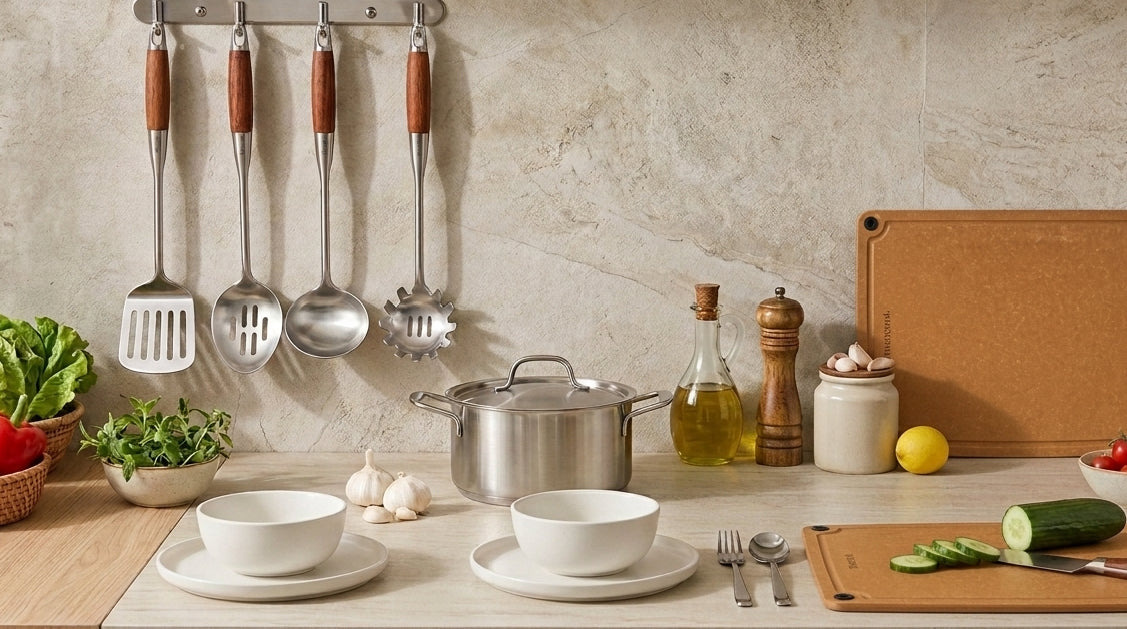
The most useful cooking utensils are the ones reached for again and again — a spoon for stirring sauces, a ladle for serving soup, a slotted tool for lifting food from liquid, a spatula for turning and serving, and a pasta spoon for noodles, vegetables, and family-style meals.
For many homes, the goal is not to fill a drawer with rarely used gadgets. The goal is to build a compact, functional kitchen utensil setup that makes daily cooking feel smoother. Whether preparing breakfast, soup, pasta, vegetables, sauces, grilled foods, or a simple family dinner, the right utensils help reduce mess, improve control, and make the movement from stove to table feel more organized.
This guide breaks down the essential kitchen utensils every home should understand, what each tool is used for, how to choose materials, how to match utensils with cookware, how to store and care for them, and how a compact utensil set can support everyday cooking without unnecessary clutter.
In This Guide
- The Quick Answer: What Kitchen Utensils Do You Need?
- What Counts as an Essential Kitchen Utensil?
- The Four Tools Every Everyday Kitchen Uses Most
- Soup Ladle: Best for Soups, Sauces, and Serving
- Slotted Spoon: Best for Draining and Lifting
- Slotted Spatula: Best for Turning and Serving
- Pasta Spoon: Best for Pasta, Noodles, and Family Meals
- Stainless Steel vs. Silicone vs. Wood vs. Nylon Utensils
- How to Match Kitchen Utensils with Cookware
- How Many Cooking Utensils Should a Home Own?
- Why a Four-Piece Cooking Utensil Set Works for Everyday Meals
- How to Store Kitchen Utensils
- How to Care for Stainless Steel Kitchen Utensils
- When to Replace Cooking Utensils
- How to Build a Kitchen Utensil Setup Over Time
- How Kitchen Utensils Support the Table
- Shop Barenthal Kitchen Essentials
- Frequently Asked Questions
The Quick Answer: What Kitchen Utensils Do You Need?
Most everyday kitchens need a small group of utensils that can handle stirring, lifting, draining, turning, serving, and plating.
A practical kitchen utensil setup usually includes:
- Soup ladle
- Slotted spoon
- Slotted spatula or turner
- Pasta spoon
- Solid spoon
- Tongs
- Whisk
- Serving spoon
- Flexible spatula
- Can opener
- Kitchen shears
For a compact kitchen, the first four tools matter most: a ladle, slotted spoon, slotted spatula, and pasta spoon. These cover many daily cooking tasks without overcrowding the drawer.
The best kitchen utensil setup depends on what the household cooks most often. A pasta-heavy home needs a pasta spoon and serving tools. A soup-focused kitchen needs a reliable ladle. A family that cooks vegetables, fried eggs, pancakes, or grilled foods needs a strong spatula. A kitchen that prepares boiled vegetables, dumplings, poached foods, or pasta needs a slotted spoon.
The goal is to own tools with clear jobs, not tools that only look useful.
What Counts as an Essential Kitchen Utensil?
An essential kitchen utensil is a tool that supports repeated cooking tasks.
It should help with at least one of these actions:
- Stirring
- Lifting
- Turning
- Draining
- Serving
- Portioning
- Mixing
- Plating
- Transferring food from cookware to table
A utensil becomes essential when it solves a common problem. A ladle solves the problem of serving soup neatly. A slotted spoon solves the problem of lifting food while leaving liquid behind. A spatula solves the problem of turning food without breaking it. A pasta spoon solves the problem of lifting noodles from a pot or serving pasta at the table.
A tool is not essential just because it exists. It becomes essential when it supports the way the home actually cooks.
Essential Utensils Should Be
- Easy to reach
- Comfortable to hold
- Appropriate for the cookware surface
- Strong enough for daily cooking
- Simple to clean
- Easy to store
- Useful across multiple meals
The most efficient kitchens are not always the ones with the most tools. They are the ones where each tool has a purpose.
The Four Tools Every Everyday Kitchen Uses Most

A complete kitchen may include many tools, but four utensils appear again and again in everyday cooking:
- Soup ladle
- Slotted spoon
- Slotted spatula
- Pasta spoon
Together, these tools cover liquids, draining, turning, lifting, and serving. They support soups, sauces, pasta, vegetables, breakfast foods, rice dishes, stews, sautéed meals, and family-style dining.
This is why a compact four-piece utensil set can be so useful. Instead of buying one-off tools separately, a coordinated set gives the kitchen a clear foundation.
Soup Ladle: Best for Soups, Sauces, and Serving

A soup ladle is one of the most practical cooking utensils in the kitchen. It is designed to scoop and serve liquids more cleanly than a standard spoon.
Use a ladle for:
- Soups
- Stews
- Broths
- Sauces
- Chili
- Gravy
- Pancake batter
- Curry
- Rice porridge
- Family-style serving
The deep bowl helps hold liquid securely, while the handle keeps hands away from heat and steam. A ladle also helps portion food more evenly, which is useful when serving guests or plating multiple bowls.
When a Ladle Matters Most
A ladle becomes especially useful when the food is too liquid for a serving spoon. Soup, sauce, broth, and stew can spill easily if served with the wrong tool. A ladle gives more control and makes the table feel more organized.
For homes that cook soup, pasta sauce, curry, chili, or family-style dishes, a ladle is not optional. It is one of the core tools.
Slotted Spoon: Best for Draining and Lifting

A slotted spoon is designed to lift food while leaving liquid behind.
This makes it useful for foods cooked in water, broth, oil, sauce, or cooking liquid. The slots allow liquid to drain away before the food reaches the plate.
Use a slotted spoon for:
- Boiled vegetables
- Dumplings
- Poached eggs
- Pasta pieces
- Fried foods
- Beans
- Braised vegetables
- Pickled foods
- Food cooked in broth
- Ingredients lifted from sauce
A slotted spoon is especially useful when the cooking liquid should not be served with the food. It creates a cleaner plate and prevents excess liquid from spreading across the dish.
Why It Belongs in an Everyday Kitchen
Without a slotted spoon, many cooks try to drain food using a standard spoon, fork, or spatula. That often creates mess, splashing, or uneven serving. A slotted spoon solves the problem more neatly.
It is also helpful at the table. For family-style meals, it can serve vegetables, sides, and foods held in sauce or broth.
Slotted Spatula: Best for Turning and Serving

A slotted spatula, also called a turner, is designed to slide under food, lift it, and turn it over.
The slotted design allows excess oil, liquid, or cooking juices to drain as food is lifted. This makes it useful for both cooking and serving.
Use a slotted spatula for:
- Eggs
- Pancakes
- Fish fillets
- Burgers
- Grilled sandwiches
- Roasted vegetables
- Fried foods
- Hash browns
- Sautéed foods
- Serving flat or delicate items
A good spatula should feel controlled. The head should slide under food without destroying its shape, and the handle should feel comfortable enough for repeated use.
What Makes a Spatula Useful
The best spatula is not only strong. It must also be thin enough to get under food, wide enough to support what it lifts, and balanced enough to control while cooking.
A slotted spatula is one of the most-used tools in breakfast cooking, weeknight meals, and casual family dinners.
Pasta Spoon: Best for Pasta, Noodles, and Family Meals

A pasta spoon is designed to lift noodles, separate strands, and serve pasta more easily.
The prongs help grip spaghetti, linguine, fettuccine, and other noodles. The center opening can help drain water as pasta is lifted from the pot.
Use a pasta spoon for:
- Spaghetti
- Linguine
- Fettuccine
- Noodles
- Pasta salads
- Steamed vegetables
- Tossed dishes
- Family-style serving
- Roasted vegetables
- Mixed side dishes
A pasta spoon is useful beyond pasta. It can help lift vegetables, serve noodles, toss ingredients, and move food from cookware to serving bowls.
Why It Helps with Serving
Pasta can be difficult to serve neatly with a standard spoon or fork. A pasta spoon gives more control, especially when serving from a large pot or bowl.
For homes that cook pasta or noodles regularly, this tool quickly becomes one of the most-used pieces in the kitchen.
Stainless Steel vs. Silicone vs. Wood vs. Nylon Utensils

Material matters because kitchen utensils touch heat, food, cookware surfaces, water, oil, and cleaning products. The right material depends on the cookware being used and the cooking style.
Stainless Steel Utensils
Stainless steel utensils feel strong, polished, and table-ready. They are useful for tasks that need structure and control, such as lifting, serving, stirring, turning, and plating.
Stainless steel tools also pair visually with stainless steel flatware, cookware, and modern kitchen finishes.
Stainless Steel Works Well For
- Stainless steel cookware
- Cast iron
- Carbon steel
- Enameled cookware
- Serving at the table
- Soups and sauces
- Pasta and vegetables
- Everyday cooking tasks
Consider Before Using
Stainless steel is strong, so it may not be the right tool for every delicate cookware surface. For nonstick cookware, follow the cookware manufacturer’s utensil guidance.
A stainless steel utensil set works best when the home wants tools that feel substantial, polished, and long-lasting in a modern kitchen.
Silicone Utensils
Silicone utensils are flexible and often used with nonstick cookware. They are helpful for scraping bowls, folding ingredients, stirring delicate sauces, and working with pans that require gentler tools.
Silicone Works Well For
- Nonstick cookware
- Mixing bowls
- Scraping batter
- Folding ingredients
- Soft sauces
- Delicate cooking surfaces
Consider Before Buying
Silicone tools can be flexible, which is useful for scraping but less useful when lifting heavier food. Some silicone utensils may bend too much for burgers, fish, roasted vegetables, or dense dishes.
Silicone is useful, but it does not replace every utensil type.
Wood Utensils
Wood utensils bring warmth and are gentle on many cookware surfaces. A wooden spoon is useful for stirring soups, sauces, stews, and sautéed dishes.
Wood Works Well For
- Stirring sauces
- Soups and stews
- Gentle cooking surfaces
- Rustic or warm kitchen styling
- Low-noise cooking
Consider Before Buying
Wood usually requires hand washing and thorough drying. It should not be soaked for long periods. Over time, wood can stain, dry out, crack, or absorb odors if not cared for properly.
Wood is useful, but it requires more care than many modern materials.
Nylon Utensils
Nylon utensils are lightweight and often affordable. They are commonly used with nonstick cookware and basic everyday cooking.
Nylon Works Well For
- Lightweight cooking
- Nonstick pans
- Simple weeknight meals
- Small kitchens
- Budget-friendly setups
Consider Before Buying
Nylon can soften, warp, or wear down depending on heat exposure and quality. It may also look less polished at the table than stainless steel or wood-handled tools.
Nylon can be practical, but it is often less refined for serving.
How to Match Kitchen Utensils with Cookware

A kitchen utensil should match the cookware surface, the heat level, and the food being prepared.
Using the wrong utensil can make cooking harder. A weak spatula may not lift food properly. A tool that is too rigid may not suit delicate pans. A spoon without slots may bring too much liquid to the plate.
Use Stainless Steel Utensils With
- Stainless steel pans
- Cast iron pans
- Carbon steel pans
- Enameled cookware
- Stockpots
- Sauce pots
- Serving bowls
- Family-style dishes
Use Silicone or Wood With
- Nonstick pans
- Delicate coated cookware
- Mixing bowls
- Sauces that need gentle stirring
- Batter or baking prep
Use a Ladle With
- Soup pots
- Sauce pots
- Stews
- Chili
- Curry
- Broth-based dishes
Use a Slotted Spoon With
- Boiled vegetables
- Dumplings
- Pasta pieces
- Food in broth
- Fried foods
- Ingredients that need draining
Use a Slotted Spatula With
- Eggs
- Pancakes
- Fish
- Burgers
- Grilled sandwiches
- Sautéed foods
- Foods that release oil or liquid
Use a Pasta Spoon With
- Noodles
- Spaghetti
- Pasta salads
- Long vegetables
- Family-style serving
- Tossed dishes
Matching the tool to the task makes cooking more controlled and cleanup easier.
How Many Cooking Utensils Should a Home Own?
Most homes do not need a large utensil collection. A focused setup works better than a crowded drawer.
Minimal Kitchen Setup
A minimal kitchen can start with:
- Soup ladle
- Slotted spoon
- Slotted spatula
- Pasta spoon
- Tongs
- Whisk
- Can opener
This setup covers common cooking tasks without taking up too much space.
Everyday Family Kitchen Setup
A family kitchen may need:
- Ladle
- Slotted spoon
- Slotted spatula
- Pasta spoon
- Solid spoon
- Tongs
- Whisk
- Flexible spatula
- Serving spoon
- Can opener
- Kitchen shears
This gives more flexibility for breakfast, lunch, dinner, meal prep, and family-style serving.
Hosting Kitchen Setup
A kitchen used for entertaining may add:
- Serving spoon
- Serving fork
- Gravy ladle
- Pastry server
- Cheese knives
- Carving fork and knife
- Extra serving utensils
- Dessert serving tools
For hosting, utensils should support both cooking and table presentation.
Why a Four-Piece Cooking Utensil Set Works for Everyday Meals
A four-piece cooking utensil set can be an efficient foundation because it focuses on tools used constantly.
The most useful four-piece setup includes:
- Soup ladle
- Slotted spoon
- Slotted spatula
- Pasta spoon
This combination supports liquids, draining, turning, lifting, serving, and pasta meals.
A Four-Piece Set Works Well For
- First apartments
- Compact kitchens
- Everyday family cooking
- Home cooks who want fewer tools
- Drawer organization
- Kitchen resets
- Housewarming setups
- Practical gifting
A four-piece set will not replace every possible kitchen tool, but it creates a strong daily foundation. From there, the home can add tongs, a whisk, a flexible spatula, a can opener, and serving tools as needed.
How to Store Kitchen Utensils
Good utensil storage makes cooking faster. The tools used most often should be easy to reach.
Countertop Crock
A countertop crock works well for utensils used daily. Keep the ladle, spatula, slotted spoon, and pasta spoon near the stove.
This setup is useful when cooking happens often and the kitchen has enough counter space.
Drawer Organizer
A drawer organizer works well for smaller kitchens. Separate tools by type:
- Stirring tools
- Turning tools
- Serving tools
- Specialty tools
- Baking tools
This helps prevent a cluttered utensil drawer.
Hanging Rail
A hanging rail works well for utensils with loops. It keeps tools visible, easy to grab, and off the counter.
This is useful for compact kitchens and homes that cook frequently.
Storage Rule
Keep daily tools within arm’s reach. Store rarely used tools farther away.
If a utensil is used every week, it belongs near the cooking area. If it is only used for holidays, it can live with serving pieces.
How to Care for Stainless Steel Kitchen Utensils
Good care helps kitchen utensils stay clean, polished, and comfortable to use.
After Every Use
- Wash food residue from the utensil.
- Clean with warm water and mild dish soap.
- Use a soft sponge or cloth.
- Dry fully before storage.
- Store in a dry drawer, crock, or hanging area.
For Wooden Handles
- Avoid soaking.
- Do not leave wet tools sitting in the sink.
- Dry handles promptly.
- Keep away from prolonged moisture.
- Hand washing helps preserve the finish over time.
For Dishwasher Cleaning
- Check the product’s care instructions first.
- If dishwasher cleaning is allowed, place utensils so water can drain properly.
- Remove and dry them after the cycle.
- For utensils with wooden handles, hand washing often helps preserve appearance.
Avoid
- Long soaking
- Harsh scrubbers
- Storing utensils while wet
- Leaving food residue on tools
- Letting wooden handles sit in water
- Overcrowding dishwasher baskets
A cooking utensil works hard during the meal, but it should still be cared for as part of the kitchen.
When to Replace Cooking Utensils
Cooking utensils should be replaced when they no longer feel clean, safe, stable, or comfortable to use.
Replace a Utensil When
- The handle becomes loose
- The head bends or warps
- Edges become sharp or damaged
- The surface becomes rough or pitted
- Wood cracks or splits
- Odors remain after cleaning
- Rust or deep corrosion appears
- The tool no longer feels stable
A damaged utensil can make cooking harder and less controlled. If a tool no longer performs its role properly, it should be removed from the everyday kitchen setup.
How to Build a Kitchen Utensil Setup Over Time
A strong kitchen setup can be built in stages.
Stage 1: Daily Cooking Foundation
Start with the four tools used most often:
- Soup ladle
- Slotted spoon
- Slotted spatula
- Pasta spoon
This creates the basic setup for soups, pasta, vegetables, breakfast foods, and daily dinners.
Stage 2: Prep and Mixing Tools
Add:
- Whisk
- Tongs
- Flexible spatula
- Can opener
- Kitchen shears
These tools expand the kitchen beyond stove work.
Stage 3: Serving Tools
Add:
- Serving spoon
- Serving fork
- Gravy ladle
- Pastry server
- Cheese knives
These support hosting, family-style meals, desserts, and shared dishes.
Stage 4: Complete Kitchen-to-Table Setup
Add:
- Knife set
- Cutting boards
- Stainless steel flatware
- Serving trays
- Dessert stand
At this stage, the kitchen is prepared not only for cooking, but also for serving and hosting.
How Kitchen Utensils Support the Table
Cooking utensils are not only for the stove. Many of them support the transition from kitchen to table.
A ladle can serve soup at the table.
A slotted spoon can serve vegetables.
A pasta spoon can serve noodles family-style.
A slotted spatula can lift portions from a baking dish.
A serving spoon can support shared sides.
A carving fork and knife can help present roasted meats.
When the tools look polished enough for serving, the meal feels more complete. This is especially useful for homes that prefer practical pieces that can move between cooking, plating, and serving.
Shop Barenthal Kitchen Essentials
Barenthal 4-Piece Cooking Utensil Set
A polished stainless steel kitchen utensil set with wooden handles, designed for soups, pasta, vegetables, turning, draining, and everyday cooking.
Shop Barenthal 4-Piece Cooking Utensil Set
Barenthal Cookware Bundle – Practical Choices
A practical kitchen bundle for everyday meal preparation, pairing prep tools with coordinated kitchen essentials.
Shop Barenthal Cookware Bundle
Barenthal 17-Piece Knife Set with Block
A complete knife block set for chopping, slicing, prep work, and everyday cooking.
Shop Barenthal 17-Piece Knife Set
Barenthal 2-Piece Composite Cutting Board Set
Two coordinated cutting board sizes for quick prep, full meals, food separation, and casual serving.
Shop Barenthal Composite Cutting Boards
Barenthal Manual Can Opener with Built-in Bottle Opener
A compact everyday kitchen tool for opening cans and bottles with one practical piece.
Shop Barenthal Manual Can Opener

Frequently Asked Questions
What Kitchen Utensils Do I Actually Need?
Most everyday kitchens need a ladle, slotted spoon, slotted spatula, pasta spoon, tongs, whisk, flexible spatula, can opener, and a few serving tools. A compact kitchen can begin with four core pieces: ladle, slotted spoon, slotted spatula, and pasta spoon. These tools support soups, pasta, vegetables, breakfast foods, and family-style meals.
What Is the Most Useful Kitchen Utensil Set?
The most useful kitchen utensil set includes tools that support multiple daily cooking tasks. A strong starter set includes a soup ladle, slotted spoon, slotted spatula, and pasta spoon. This combination helps with serving liquids, draining food, turning ingredients, lifting pasta, and moving food from cookware to the table.
Is a Four-Piece Cooking Utensil Set Enough?
A four-piece cooking utensil set can be enough for a compact kitchen or as a daily cooking foundation. It works especially well when the set includes a ladle, slotted spoon, slotted spatula, and pasta spoon. Larger kitchens may still add tongs, a whisk, a flexible spatula, a can opener, and serving utensils.
What Is a Soup Ladle Used For?
A soup ladle is used for serving soups, stews, sauces, chili, gravy, broth, curry, and other liquid-based foods. The deep bowl holds liquid more securely than a regular spoon, helping reduce spills and create cleaner portions when serving from a pot or large bowl.
What Is a Slotted Spoon Used For?
A slotted spoon is used to lift food while leaving liquid behind. It works well for boiled vegetables, dumplings, poached eggs, fried foods, beans, pasta pieces, and ingredients cooked in broth or sauce. It helps create a cleaner plate by draining excess liquid before serving.
What Is a Slotted Spatula Used For?
A slotted spatula is used for turning, lifting, and serving foods that release oil or liquid. It works well for eggs, pancakes, fish, burgers, grilled sandwiches, roasted vegetables, and sautéed foods. The slots allow extra liquid or oil to drain as food is lifted.
What Is a Pasta Spoon Used For?
A pasta spoon is used to lift and serve noodles, spaghetti, linguine, fettuccine, pasta salads, and mixed dishes. The prongs help grip pasta, while the center opening can help drain water. It is also useful for serving vegetables and family-style dishes.
Are Stainless Steel Kitchen Utensils Good?
Stainless steel kitchen utensils are strong, polished, and useful for everyday cooking and serving. They work well with stainless steel cookware, cast iron, carbon steel, stockpots, serving bowls, and many family-style dishes. For delicate nonstick cookware, follow the cookware manufacturer’s utensil guidance.
Are Wooden Handles Good for Cooking Utensils?
Wooden handles can feel comfortable and add warmth to kitchen tools. They also help create a refined look when utensils are stored on the counter or used for serving. Wooden handles should be kept dry, not soaked, and cleaned with care to help preserve their appearance over time.
How Should I Store Kitchen Utensils?
Store daily utensils near the stove in a crock, drawer organizer, or hanging rail. Keep the most-used tools within easy reach and store rarely used serving or specialty pieces farther away. Utensils should be fully dry before storage to keep the kitchen clean and organized.
When Should Cooking Utensils Be Replaced?
Cooking utensils should be replaced when handles loosen, wood cracks, surfaces become rough or damaged, edges become sharp, tools warp, or food odors remain after cleaning. A utensil that no longer feels stable or clean should not stay in the everyday cooking setup.
What Is the Difference Between Cooking Utensils and Serving Utensils?
Cooking utensils are used during food preparation and cooking. Serving utensils are used to present or portion food at the table. Some tools can do both. A ladle can serve soup, a slotted spoon can serve vegetables, and a pasta spoon can move from pot to table for family-style meals.
Final Thoughts
A useful kitchen is not built from endless gadgets. It is built from reliable tools that make everyday cooking easier.
A ladle helps serve soup and sauces cleanly. A slotted spoon lifts food while leaving liquid behind. A slotted spatula turns and serves without adding mess. A pasta spoon makes noodles and family-style meals easier to handle. Together, these tools create a practical foundation for daily cooking.
From there, a home can add tools based on real habits: tongs for gripping, a whisk for mixing, a can opener for pantry cooking, serving pieces for the table, knives for prep, and cutting boards for a smoother kitchen workflow.
The best kitchen utensil setup is the one that helps food move naturally from prep to cooking to serving.
Cook with control. Serve with ease. Build a kitchen that works beautifully every day.