
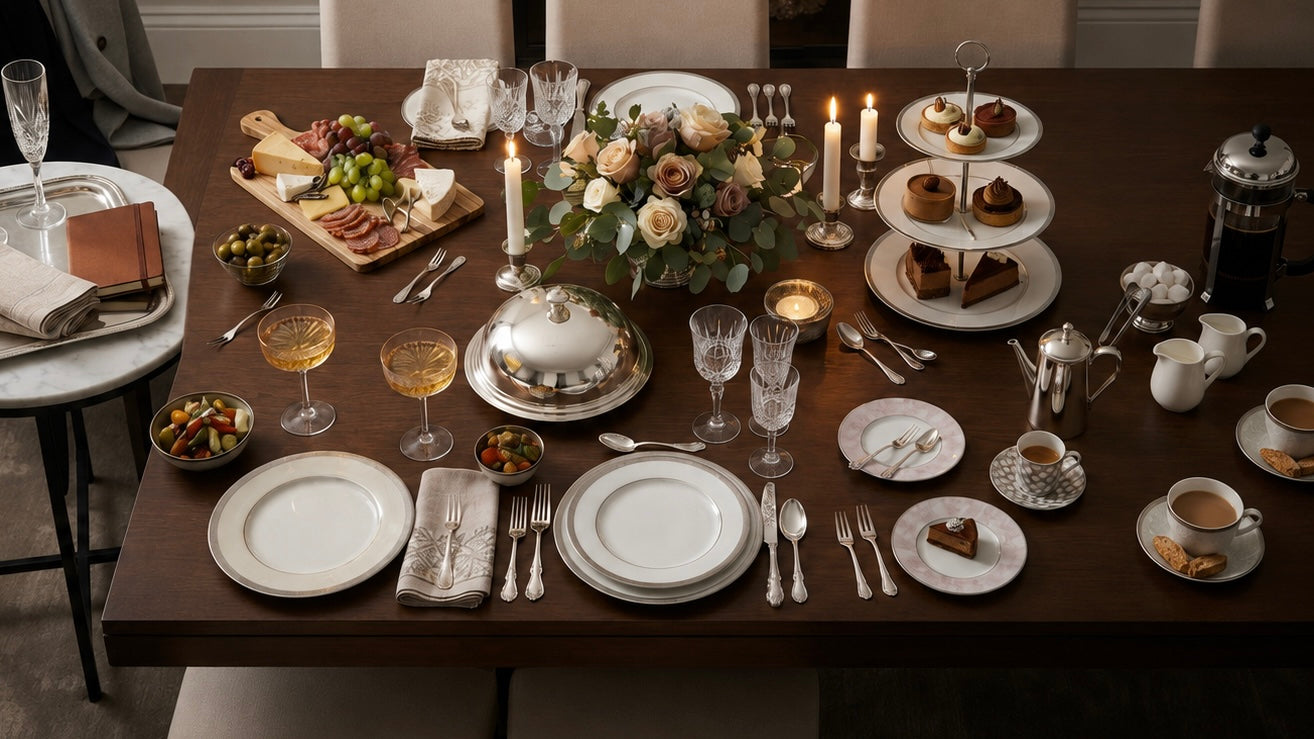
Hosting a dinner party at home does not have to feel complicated. The best gatherings are not built around perfection. They are built around thoughtful preparation, a table that feels inviting, and the right tools placed where guests actually need them.
A successful dinner party begins before the first guest arrives. It starts with the menu, the prep surface, the serving plan, the flatware, the serving utensils, and the way food will move from kitchen to table.
When everything has a place, hosting feels easier. Guests know where to sit. Food is simple to serve. The table looks polished without feeling overly formal. The kitchen stays more organized. The host can spend less time searching for utensils and more time enjoying the meal.
This guide breaks down how to host a dinner party at home, from planning the table setting and choosing flatware to organizing serving pieces, carving tools, cutting boards, dessert displays, and a realistic prep timeline.
In This Guide
- The Quick Answer: What Do You Need for a Dinner Party?
- Start with the Dinner Party Flow
- Choose the Right Hosting Style: Plated, Family-Style, or Buffet
- Dinner Party Table Setting Basics
- How Many Place Settings Do You Need?
- Flatware Essentials for Dinner Parties
- Serving Pieces Every Dinner Party Table Needs
- Cutting Boards and Serving Boards
- Steak Knives and Carving Tools
- How to Set Up a Dessert or Coffee Station
- Dinner Party Prep Timeline
- How to Keep the Table Functional and Beautiful
- Common Dinner Party Hosting Mistakes
- Shop Barenthal Dinner Party Essentials
- Frequently Asked Questions
The Quick Answer: What Do You Need for a Dinner Party?
A dinner party needs more than food. It needs a clear table setup, enough place settings, serving tools for shared dishes, a prep plan, and a layout that guests can use comfortably.
A practical dinner party setup includes:
- Dinner plates
- Salad or appetizer plates
- Flatware for every guest
- Extra forks, knives, and spoons
- Steak knives if the menu requires them
- Serving spoons
- Slotted serving spoon
- Gravy ladle or sauce spoon
- Pastry server or cake server
- Carving knife and fork for roasts or poultry
- Cutting board or serving board
- Napkins
- Water glasses
- Wine glasses or drinkware
- Dessert forks or teaspoons
- A simple centerpiece
- Space for shared dishes
The table does not need to be crowded. In fact, a dinner party often feels more elegant when the table is clean, balanced, and easy to use.
The most important rule is simple: every dish should have the correct serving piece before guests sit down.
Start with the Dinner Party Flow

Before setting the table, think through how the evening will move.
A dinner party usually has several stages:
- Arrival
- Drinks or appetizers
- Main meal
- Dessert
- Coffee or final drinks
- Casual conversation after the meal
Each stage needs different tools. Appetizers may need a board and small knives. The main meal may need serving spoons, flatware, steak knives, or a carving set. Dessert may need teaspoons, pastry servers, small plates, or a tiered stand.
When the flow is clear, the table becomes easier to set.
Questions to Answer Before Setting the Table
- How many guests are coming?
- Will food be plated, shared family-style, or served buffet-style?
- Does the menu include meat that needs carving?
- Will the meal include soup, sauce, or gravy?
- Will dessert be sliced, picked up by hand, or served from a stand?
- Will guests need steak knives?
- Where will drinks be served?
- Where will extra napkins and utensils go?
A good dinner party setup starts with the meal plan, not the decoration.
Choose the Right Hosting Style: Plated, Family-Style, or Buffet
The way food is served changes the tools needed at the table.
Plated Dinner
A plated dinner means the host prepares each plate before it reaches the table. This creates a more formal experience and keeps the table cleaner because fewer serving bowls are needed.
Plated Dinner Works Well For
- Smaller dinner parties
- More formal meals
- Courses served in order
- Menus where presentation matters
- Dishes that are easier to portion in the kitchen
What to Prepare
- Complete flatware at each seat
- Steak knives if needed
- Dessert flatware if dessert is plated later
- Serving tools in the kitchen
- Extra napkins
- Space for each plate to be served smoothly
A plated dinner looks polished, but it requires more kitchen timing.
Family-Style Dinner
A family-style dinner places shared dishes on the table so guests can serve themselves.
This style feels warm, relaxed, and generous. It works especially well for pasta, roasted vegetables, salads, sides, bread, casseroles, and shared mains.
Family-Style Dinner Works Well For
- Casual hosting
- Holiday meals
- Large sides
- Shared dishes
- Comfortable home dining
- Guests who enjoy serving themselves
What to Prepare
- Serving spoon for each side
- Slotted spoon for foods with liquid
- Ladle for sauces, soups, or gravy
- Carving set for large proteins
- Cutting board or platter for bread
- Enough space in the center of the table
Family-style dining needs serving tools. Without them, guests may use personal utensils in shared dishes, which makes the table feel less organized.
Buffet-Style Dinner
A buffet places food on a sideboard, kitchen island, or separate serving area. Guests fill their plates and then sit at the table.
This works well when the dining table is small or when there are many guests.
Buffet-Style Dinner Works Well For
- Larger gatherings
- Small dining tables
- Casual parties
- Mixed menus
- Holiday meals
- Events with many dishes
What to Prepare
- Serving utensils for every dish
- Plates at the beginning of the buffet
- Flatware and napkins near the end
- A clear food order
- Extra serving tools nearby
- A separate drink area if possible
A buffet works best when guests can move through the setup without crossing paths or reaching awkwardly.
Dinner Party Table Setting Basics

A dinner party table should feel polished but not crowded.
Start with the essentials:
- Plate
- Fork
- Knife
- Spoon if needed
- Napkin
- Glassware
- Serving pieces
- One simple centerpiece
For most dinner parties, a clean table with matching flatware and thoughtful spacing feels better than a table overloaded with decorations.
Basic Table Setting
- Fork on the left side of the plate.
- Knife on the right side, blade facing inward.
- Spoon to the right of the knife if needed.
- Napkin under the fork, beside the plate, or on top of the plate.
- Water glass above the knife.
- Wine glass or additional drinkware to the right of the water glass.
More Complete Table Setting
- Salad fork goes outside the dinner fork.
- Dinner fork sits closer to the plate.
- Dinner knife sits to the right of the plate.
- Spoon sits to the right of the knife.
- Dessert fork or teaspoon can be placed above the plate or brought out later.
Table Setting Rule
Place utensils in the order guests will use them, from outside to inside.
This keeps the table easy to understand and creates a more graceful dining experience.
How Many Place Settings Do You Need?
The number of place settings should match the number of guests, plus extras.
For a dinner party, plan for at least one complete place setting per guest. If the meal includes multiple courses, dessert, or coffee, extra pieces become useful.
Place Setting Count
- 4 guests: 4 complete place settings, plus 1–2 extra pieces
- 6 guests: 6 complete place settings, plus extra forks and teaspoons
- 8 guests: 8 complete place settings, plus extra serving pieces
- 10–12 guests: 10–12 complete place settings, plus serving utensils and dessert flatware
If the table includes appetizers, salad, main course, dessert, and drinks, one utensil per person may not be enough.
Extra Pieces Worth Having
- Extra dinner forks
- Extra salad forks
- Extra teaspoons
- Extra dinner knives
- Extra serving spoons
- Extra dessert forks
- Extra napkins
Extra pieces prevent the host from having to wash utensils during the meal.
Flatware Essentials for Dinner Parties

Flatware is one of the most visible parts of the table. It frames each place setting and helps the meal feel organized.
A complete flatware setting may include:
- Dinner fork
- Salad fork
- Dinner knife
- Dinner spoon
- Teaspoon
For casual dinner parties, a three-piece setting may be enough:
- Dinner fork
- Dinner knife
- Spoon if needed
For more complete hosting, a five-piece setting gives the table more flexibility.
- Dinner Fork
Used for the main course, pasta, vegetables, and everyday dishes. - Salad Fork
Used for salads, appetizers, desserts, fruit, and smaller plates. - Dinner Knife
Used for soft proteins, vegetables, bread, pancakes, and general table cutting. - Dinner Spoon
Used for soup, rice dishes, stews, sauces, and larger spoon servings. - Teaspoon
Used for coffee, tea, desserts, yogurt, fruit, and small bites.
A consistent flatware set helps the table look intentional from the first seat to the last.
Serving Pieces Every Dinner Party Table Needs

Serving pieces make the meal easier to share.
Every shared dish should have a serving utensil. This keeps the table cleaner and prevents guests from using personal forks or spoons in shared food.
Useful Serving Pieces
- Serving spoon
- Slotted serving spoon
- Serving fork
- Gravy ladle
- Pastry server
- Cake server
- Cheese knife
- Carving knife and fork
- Small tongs
- Serving board
Match the Serving Piece to the Dish
- Use a serving spoon for vegetables, rice, potatoes, pasta, and casseroles.
- Use a slotted spoon for foods with liquid.
- Use a ladle for sauces, gravies, soups, and dressings.
- Use a pastry server for cakes, pies, tarts, and quiche.
- Use a carving set for roasts, turkey, ham, chicken, and larger proteins.
- Use a serving board for bread, cheese, appetizers, fruit, or small bites.
The right serving piece makes the table feel more controlled.
Cutting Boards and Serving Boards

A cutting board can do more than support kitchen prep. It can also become part of the dinner party table.
A clean cutting board or serving board can hold:
- Bread
- Cheese
- Fruit
- Crackers
- Appetizers
- Sliced meats
- Small desserts
- Crostini
- Pastries
- Shared snacks
A board adds warmth and texture to the table. It also creates a natural space for guests to gather.
When to Use a Board
- Use a board during appetizers.
- Use a board for bread at the table.
- Use a board to serve fruit or cheese.
- Use a board for casual dessert bites.
- Use a board when the table needs a relaxed centerpiece.
Board Styling Rule
Keep it simple.
Start with the largest items first, then add smaller pieces around them. Leave space for guests to pick up food easily. Add a small knife, fork, or serving utensil if the food needs cutting or spreading.
A board should feel generous, not overcrowded.
Steak Knives and Carving Tools

Dinner knives are useful for everyday meals, but some menus need more cutting power.
If the dinner party includes steak, pork chops, lamb, roasted chicken, or thick sandwiches, steak knives should be included at each place setting.
If the meal includes turkey, roast chicken, ham, prime rib, roast beef, pork loin, or another large cut, a carving knife and fork set is useful.
Use Steak Knives For
- Steak
- Pork chops
- Lamb
- Roasted meats
- Grilled chicken
- Thick sandwiches
- Crusty bread
- Firm roasted vegetables
Use a Carving Set For
- Turkey
- Roast chicken
- Ham
- Roast beef
- Prime rib
- Pork loin
- Lamb
- Large poultry
Steak knives support the guest experience at the plate. A carving set supports the serving experience before food reaches each plate.
Both can make a dinner party feel more polished.
How to Set Up a Dessert or Coffee Station

Dessert does not need to stay on the main dinner table.
A separate dessert or coffee station can make the end of the meal feel easier and more relaxed. It also frees the dining table from extra plates, trays, cups, and serving tools.
A dessert station can include:
- Dessert plates
- Dessert forks
- Teaspoons
- Pastry server
- Cake server
- Small tongs
- Napkins
- Coffee cups
- Tea cups
- Cream and sugar
- Dessert stand
- Serving board
Dessert Station Setup
- Place plates first.
- Place dessert next.
- Place serving utensils beside each dessert.
- Place forks, spoons, and napkins at the end.
- Keep coffee or tea separate if the table is crowded.
A tiered stand works well for cookies, cupcakes, pastries, fruit, and small bites. A flat board works better for cakes, pies, tarts, or anything that needs slicing.
Dinner Party Prep Timeline

A dinner party feels easier when the work is spread out.
The goal is to avoid doing everything in the last hour before guests arrive.
One Day Before
- Set the menu.
- Confirm guest count.
- Check flatware and serving pieces.
- Wash serving boards and dessert stands.
- Plan table layout.
- Prepare anything that can be made ahead.
- Clear counter space.
- Check napkins, plates, and glassware.
Morning of the Dinner Party
- Prepare sauces, desserts, or cold dishes.
- Set aside serving utensils for each dish.
- Wash and dry flatware.
- Prepare cutting boards and serving boards.
- Set up the dessert station if possible.
- Chill drinks if needed.
Two Hours Before
- Set the table.
- Place plates, flatware, glasses, and napkins.
- Set up serving boards.
- Prepare appetizers.
- Confirm the cooking timeline.
- Place serving utensils beside each dish or tray.
Thirty Minutes Before
- Light candles or adjust lighting.
- Place water on the table.
- Prepare appetizers.
- Warm dishes if needed.
- Clear the sink and dishwasher.
- Keep extra napkins and flatware nearby.
Right Before Guests Sit Down
- Add hot dishes to the table or buffet.
- Place serving utensils in each dish.
- Bring out bread, butter, sauces, and sides.
- Set carving tools if needed.
- Check that each guest has the correct flatware.
A clear timeline helps the host stay calm and present.
How to Keep the Table Functional and Beautiful
A dinner party table should be easy to use.
Decorations should not block food, conversation, or serving pieces. Guests should be able to reach dishes without moving candles, flowers, or oversized centerpieces.
Keep the Table Functional By
- Using low centerpieces
- Leaving space for serving dishes
- Keeping serving utensils near food
- Avoiding oversized décor
- Placing extra napkins nearby
- Keeping water easy to reach
- Moving dessert to a separate station if needed
- Using boards and trays to organize food
Keep the Table Beautiful By
- Using matching flatware
- Keeping the color palette simple
- Adding one natural element
- Repeating materials such as stainless steel, wood, glass, or linen
- Choosing one focal point
- Letting food presentation be part of the design
The strongest tables look thoughtful and still work comfortably.
Common Dinner Party Hosting Mistakes
A dinner party can become stressful when small details are missed.
Mistake 1: Not Having Enough Flatware
Guests should not have to reuse a fork from salad through dessert unless the meal is intentionally casual.
Keep extra forks, spoons, and knives nearby.
Mistake 2: No Serving Utensils for Shared Dishes
Every shared dish needs its own serving piece.
A beautiful table quickly becomes messy when guests have to improvise.
Mistake 3: Too Much on the Table
Overcrowding makes it difficult to serve food and hold conversation.
Keep the centerpiece low and leave space for dishes.
Mistake 4: Forgetting Dessert Tools
Cake, pie, and tart need the right serving piece.
Keep a pastry server, dessert forks, teaspoons, and napkins ready before dessert begins.
Mistake 5: No Prep Timeline
Trying to cook, set the table, wash tools, and greet guests at the same time creates stress.
Prepare as much as possible before guests arrive.
Mistake 6: Using the Wrong Knife
Dinner knives are not always enough.
Use steak knives for firmer foods and a carving set for large roasts or poultry.
Shop Barenthal Dinner Party Essentials
Barenthal Couture 64-Piece Silverware Set for 12
A complete flatware collection for twelve place settings, formal dining, holidays, and hosting with included serving pieces.
Shop Barenthal Couture 64-Piece Silverware SetBarenthal Couture 2-Piece Serving Set
A polished serving set with a gravy ladle and pastry server for sauces, gravies, desserts, pastries, and shared table moments.
Shop Barenthal Couture 2-Piece Serving SetBarenthal 2-Piece Carving Knife and Fork Set, 18/10 Stainless Steel
A carving knife and fork set for turkey, chicken, roasts, and elegant table serving.
Shop Barenthal Carving Knife and Fork SetBarenthal 6-Piece Classic Serrated Steak Knife Set, German Stainless Steel
A polished serrated steak knife set for everyday dinners, grilled meals, and hosting.
Shop Barenthal Classic Serrated Steak KnivesBarenthal Composite Cutting Boards
Practical prep and serving boards for bread, cheese, appetizers, sliced meats, and everyday hosting.
Shop Barenthal Composite Cutting BoardsBarenthal 2-Tier Wood Fiber Cupcake Stand
A two-tier dessert and appetizer stand for cupcakes, pastries, fruit, snacks, tea parties, holidays, and table display.
Shop Barenthal 2-Tier Cupcake Stand
Frequently Asked Questions
What Do I Need to Host a Dinner Party at Home?
To host a dinner party at home, prepare enough place settings, flatware, glasses, napkins, serving utensils, serving boards, and tools for the menu. If the meal includes shared dishes, each dish needs its own serving utensil. If the meal includes steak, roasts, or dessert, include steak knives, carving tools, pastry servers, and dessert flatware.
How Do I Set a Table for a Dinner Party?
Start with plates, then place forks on the left and knives and spoons on the right. Knife blades should face the plate. Glassware sits above the knife. Napkins can go under the fork, beside the plate, or on the plate. Add serving pieces and keep centerpieces low so guests can see and serve comfortably.
How Many Place Settings Do I Need for a Dinner Party?
You need one complete place setting per guest, plus a few extra utensils for dessert, dropped pieces, or additional courses. For four to six guests, a 20-piece silverware set may be enough for a simple meal. For larger gatherings or formal dinners, a larger flatware set with serving pieces offers more flexibility.
What Serving Utensils Do I Need for a Dinner Party?
Useful serving utensils include serving spoons, slotted spoons, serving forks, gravy ladles, pastry servers, cake servers, small tongs, and a carving knife and fork. The exact setup depends on the menu. Each shared dish should have its own serving piece before guests sit down.
Do I Need Steak Knives for a Dinner Party?
Steak knives are useful when the menu includes steak, pork chops, lamb, roasted meats, grilled chicken, thick sandwiches, crusty bread, or firm roasted vegetables. If the meal only includes soft foods, pasta, soup, or fish, standard dinner knives may be enough.
What Is the Best Way to Serve Food at a Dinner Party?
Food can be served plated, family-style, or buffet-style. Plated service feels more formal. Family-style service feels warm and relaxed. Buffet-style service works well for larger gatherings or smaller dining tables. The best method depends on guest count, table space, and the type of food being served.
How Do I Keep a Dinner Party Table from Looking Crowded?
Use a simple color palette, low centerpieces, and only the serving pieces needed for the meal. Move drinks, desserts, or extra dishes to a sideboard if the dining table is small. Leave enough space for plates, glasses, flatware, serving dishes, and guests’ hands.
What Should Be on a Dessert Station?
A dessert station should include dessert plates, dessert forks or teaspoons, napkins, pastry server, cake server, small tongs, and the desserts themselves. A tiered stand works well for cupcakes, cookies, pastries, and fruit. Cakes, pies, and tarts should sit on a flat surface where they can be sliced cleanly.
How Early Should I Set the Table Before a Dinner Party?
Set the table at least two hours before guests arrive if possible. For larger gatherings, setting the table the night before can reduce stress. Serving pieces, flatware, boards, dessert tools, and napkins should be checked before cooking begins.
How Do I Make a Dinner Party Feel More Polished?
Use matching flatware, set out serving pieces before the meal begins, keep the centerpiece low, and match each shared dish with the correct utensil. Small details such as clean glassware, folded napkins, a serving board, and a planned dessert station can make the dinner feel more refined without making it formal.
What Is the Difference Between Family-Style and Buffet-Style Dining?
Family-style dining places shared dishes on the table so guests serve themselves while seated. Buffet-style dining places food on a separate surface where guests fill their plates before sitting down. Family-style feels more intimate, while buffet-style works better for larger gatherings or limited table space.
What Is the Biggest Mistake When Hosting a Dinner Party?
One of the biggest mistakes is not planning how food will be served. A menu may be delicious, but the meal becomes stressful if there are not enough serving utensils, flatware, plates, or clear spaces on the table. A dinner party works best when the serving flow is planned before guests arrive.
Final Thoughts
A dinner party does not need to be formal to feel memorable.
The strongest gatherings are built from simple choices: a clear table setting, enough flatware, useful serving pieces, clean boards, the right knives, and a plan for how food moves from kitchen to table.
When each dish has a serving utensil, each guest has a complete place setting, and the table has enough space to function, hosting becomes easier. The meal feels more polished because the details are already handled.
Set the table with intention. Serve with confidence. Let the evening feel effortless.